Index Funds vs ETFs: What Is the Difference and Which Should You Buy?
Table of Contents
Index Funds vs ETFs: What Is the Difference and Which Should You Buy?

TL;DR: Index funds and ETFs are more similar than different — both track a market index passively, both have low expense ratios, and both deliver better long-term returns than most actively managed funds. The key differences: ETFs trade like stocks throughout the day (minimum one share purchase), while traditional index mutual funds trade once per day at closing price (often with minimums). For most beginners in 2026, ETFs at $0-minimum brokerages make the most practical starting point.
What Is an Index Fund?
An index fund is any investment vehicle — mutual fund or ETF — that tracks a market index by holding the same securities in the same proportions. The S&P 500 Index, for example, tracks the 500 largest U.S. publicly traded companies. An S&P 500 index fund holds all 500 companies in proportion to their market capitalization, meaning Apple and Microsoft (the two largest by market cap in 2026) represent larger positions than smaller companies.
The term "index fund" most commonly refers to index mutual funds — specifically, traditional mutual funds that use passive indexing rather than active stock selection. ETFs (Exchange-Traded Funds) are a separate legal structure that can also be index-tracking, creating the terminology overlap that confuses beginners.
What Is an ETF?
An ETF is a basket of securities that trades on a stock exchange throughout the day, just like an individual stock. The first U.S. ETF, the SPDR S&P 500 ETF (ticker: SPY), launched in January 1993. As of 2024, global ETF assets under management reached $11.5 trillion according to ETFGI, a leading ETF analytics firm.
ETFs can track almost any index — U.S. stocks, international stocks, bonds, real estate (REITs), commodities, and more. The most popular ETFs for beginners track broad market indices: VTI (total U.S. market), VOO (S&P 500), and VXUS (total international market).
Key Differences: Index Mutual Funds vs ETFs
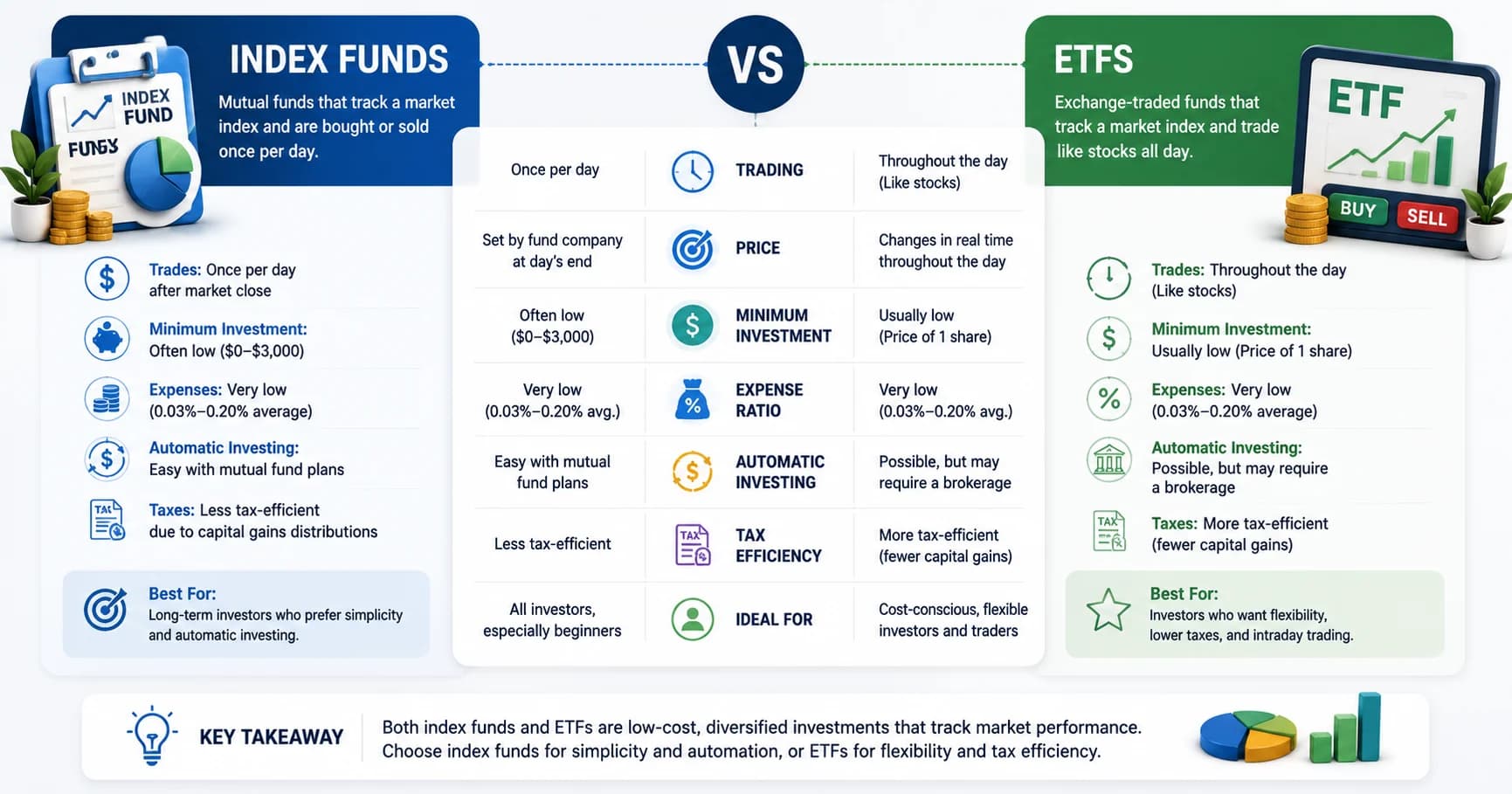
| Feature | Index Mutual Fund | ETF |
|---|---|---|
| Trading | Once per day at closing NAV | Throughout the day like a stock |
| Minimum investment | Often $1,000–$3,000 | Price of one share (or $1 with fractional) |
| Expense ratios | 0%–0.20% (low-cost providers) | 0.03%–0.20% (broad index ETFs) |
| Tax efficiency | Less tax-efficient (capital gains distributions) | More tax-efficient (in-kind creation/redemption) |
| Automatic investment | Yes — easy to set up | Depends on brokerage (most support it now) |
| Dividend reinvestment | Automatic | Manual or brokerage-automated |
| Broker flexibility | Usually only at fund company | Any brokerage account |
Expense Ratios: The Most Important Number
Both index mutual funds and ETFs can have very low expense ratios — the annual fee as a percentage of assets. This is the most important cost to compare. The difference between a 0.03% and a 1.0% expense ratio costs approximately $140,000 in fees over 30 years on a $100,000 starting investment at 8% returns.
The lowest-cost options in 2026:
- Fidelity ZERO funds (FZROX, FZILX, FXNAX): 0.00% expense ratio — literally no annual fee. Available exclusively in Fidelity accounts.
- Vanguard Total Stock Market ETF (VTI): 0.03% expense ratio. Available at any brokerage.
- Schwab Total Stock Market Index (SWTSX): 0.03% expense ratio as a mutual fund.
- Vanguard S&P 500 ETF (VOO): 0.03% expense ratio.
Avoid ETFs with expense ratios above 0.50% for broad market index funds — there is no evidence that higher fees produce better returns for passive index strategies. Use our investment calculator to model how different expense ratios affect your ending balance.
Tax Efficiency: ETFs Win
ETFs have a structural advantage in taxable brokerage accounts. When investors sell mutual fund shares, the fund may need to sell securities to raise cash, potentially triggering capital gains that are distributed to all shareholders — including those who did not sell. ETFs avoid this through an "in-kind" creation and redemption mechanism where institutional investors (called authorized participants) exchange baskets of securities for ETF shares, avoiding taxable sales.
Morningstar research from 2023 found that the average equity ETF distributed zero capital gains over the prior 10 years, while mutual funds distributed capital gains in 45% of those fund-years. In tax-advantaged accounts (401k, IRA), this difference is irrelevant — all growth is tax-deferred or tax-free regardless of fund structure.
Which Is Better for Automatic Investing?
Mutual funds are traditionally easier for automating dollar-amount contributions: you can instruct Fidelity or Vanguard to invest exactly $500 per month without worrying about share prices or fractional shares. ETFs trade in whole shares (or fractional shares at brokerages that support them), making exact dollar automation slightly more complex.
In 2026, most major brokerages — Fidelity, Schwab, and Robinhood — support fractional ETF share purchases, effectively eliminating this difference. Set up an automatic monthly purchase of a fixed dollar amount in your chosen ETF and the brokerage handles the fractional share math.
The Practical Verdict for 2026
For most beginners at $0-minimum brokerages like Fidelity or Schwab, the choice between ETFs and mutual funds is largely irrelevant — the same underlying index is available in both structures at near-identical costs. Here is the practical guidance:
- At Fidelity: Use FZROX (0% ER, total U.S. market mutual fund) for retirement accounts. No minimum, no fee, automatic investment built in.
- At Vanguard: Use VTSAX (0.04% ER, total U.S. market mutual fund, $3,000 minimum) or VTI ETF (0.03% ER, no minimum).
- At Schwab: Use SWTSX (0.03% ER, total U.S. market mutual fund) or Schwab ETFs.
- Any brokerage taxable account: Prefer ETFs for the tax-efficiency advantage.
Read our complete beginner investing guide to understand account types, asset allocation, and how to automate your investments before choosing between fund structures. For projecting what either option grows to over time, use our compound interest calculator.
Frequently Asked Questions
Are index funds and ETFs the same thing?
Not exactly. An ETF is a legal structure (a fund that trades on an exchange like a stock). An index fund is an investment strategy (passively tracking a market index). Most popular ETFs are index-tracking, and most index funds are structured as mutual funds. The terms overlap because the majority of ETFs are passive index trackers, but there are also actively managed ETFs and index mutual funds.
Which has lower fees — index funds or ETFs?
Both can have very low fees. The lowest-cost options are essentially tied: Fidelity ZERO mutual funds charge 0.00%, while Vanguard and Schwab ETFs charge 0.03%. For practical purposes, any index fund or ETF with an expense ratio below 0.10% is cost-competitive. The fund company and specific fund matter more than the legal structure.
Can you lose all your money in an index fund?
A total U.S. stock market index fund would go to zero only if every publicly traded company in the United States went bankrupt simultaneously — an event that would also mean the collapse of the U.S. economy. In practice, the S&P 500 has never permanently lost value over any 20-year period in its history. Short-term losses of 30–50% are possible and have occurred (2000–2002, 2008–2009, 2020), but all have been followed by full recovery.
What is the minimum to invest in an ETF?
At brokerages that support fractional shares (Fidelity, Schwab, Robinhood), you can invest as little as $1. At brokerages that require whole shares, the minimum is one share — approximately $250–$290 for VTI and $480–$520 for VOO in 2026. Most traditional index mutual funds require $1,000–$3,000 minimums, with the notable exception of Fidelity ZERO funds ($0 minimum).
Should beginners buy ETFs or mutual funds?
For beginners at Fidelity or Schwab, the Fidelity ZERO funds or Schwab index mutual funds offer the easiest path: $0 minimum, automatic investment, no expense ratio, and no need to think about share prices. For beginners at other brokerages, ETFs like VTI or VOO are the best alternative. The underlying index matters more than the structure — a low-cost S&P 500 ETF and a low-cost S&P 500 mutual fund will produce nearly identical long-term results.
Frequently Asked Questions
Our Methodology
All calculator content on CalculatorApp.me is reviewed by subject-matter experts, cross-referenced with official sources, and updated regularly for accuracy. Our formulas and data are verified against industry standards and government publications.
Jordan Hayes
Verified AuthorPersonal Finance Content Strategist
Jordan is a personal finance content strategist with 9+ years writing about mortgages, retirement, tax strategy, and budgeting. Every guide is cross-referenced with IRS publications, Federal Reserve data, and CFPB guidance to make complex calculations accessible. Editor at CalculatorApp.me.
Found this helpful? Share it!
Stay Updated
Get notified when we launch new calculators and features.
No spam. Unsubscribe anytime.