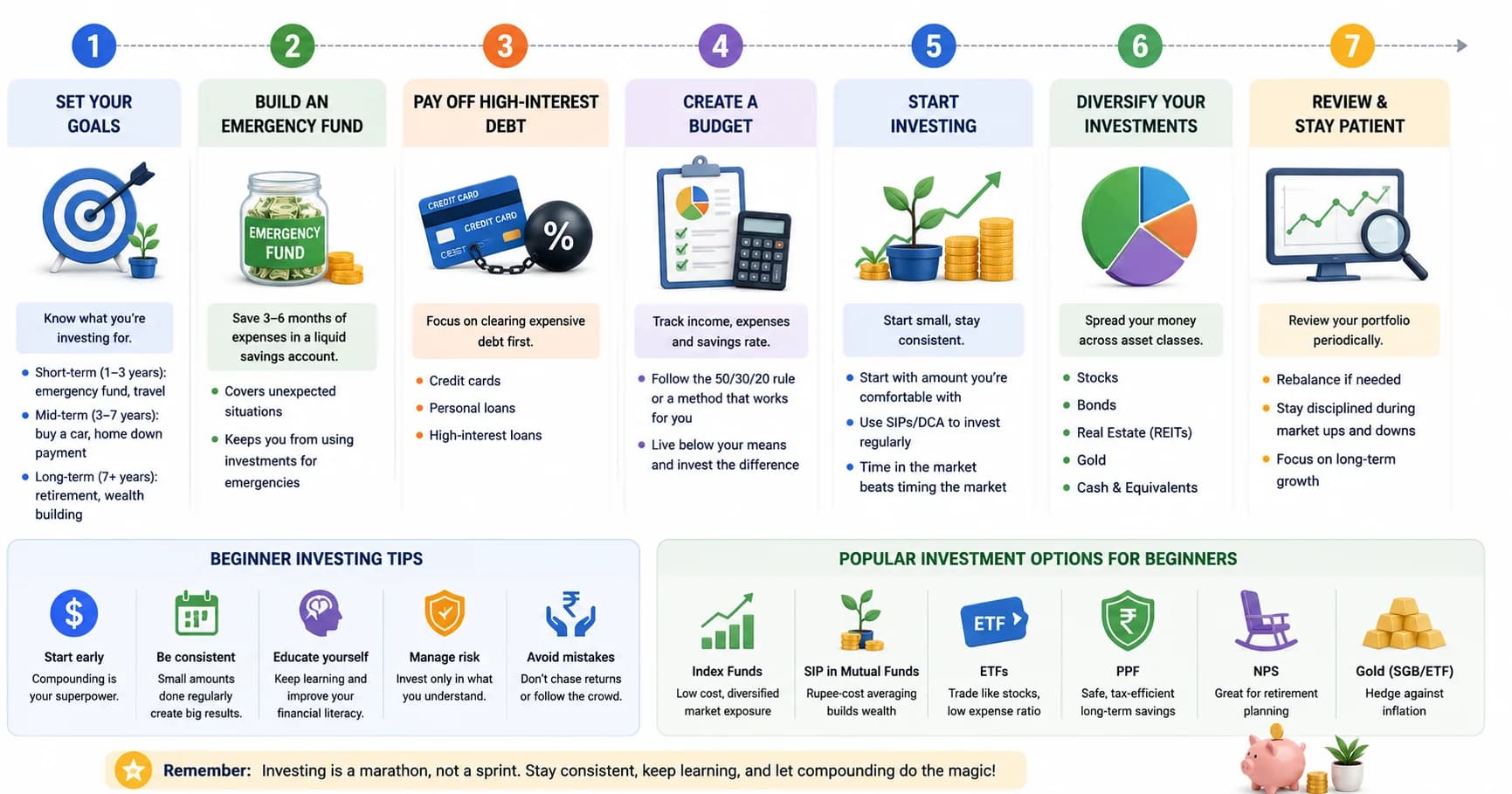
How to Invest Money for Beginners: Step-by-Step Guide for 2026
Table of Contents
How to Invest Money for Beginners: Step-by-Step Guide for 2026

TL;DR: Investing is the process of putting money to work so it grows over time. The S&P 500 has returned an average of 10.2% annually since 1957 (Vanguard, 2024), meaning $10,000 invested today becomes approximately $117,000 in 30 years. The most important step is starting — even $50 per month compounds into meaningful wealth over decades. This guide covers everything a beginner needs to invest in 2026: where to open an account, what to buy, and how much to invest.
Why Investing Is Not Optional in 2026
Inflation averaged 3.4% in the United States in 2023 per the Bureau of Labor Statistics. A savings account yielding 1–2% APY loses purchasing power every year in that environment. Investing — specifically in diversified equity index funds — is the primary mechanism by which most Americans outside the top income percentile build lasting wealth. The Federal Reserve's 2022 Survey of Consumer Finances found that 57.7% of families owned stocks directly or through retirement accounts, and the median family holding stocks had a net worth nearly 10 times higher than those without equity exposure.
The barrier is not knowledge — it is starting. Use our investment calculator to see what any monthly contribution becomes over time at historical market returns.
Step 1: Build Your Emergency Fund First
Before investing a single dollar in the market, build a cash emergency fund of 3–6 months of essential expenses. Most financial planners recommend this sequencing because money invested in the stock market can lose 20–50% of its value in any given year. If your car breaks down or you lose your job, you should not need to sell investments at a loss to cover living expenses.
According to the Federal Reserve's 2024 Report on the Economic Well-Being of U.S. Households, 37% of Americans could not cover a $400 emergency from savings. Investing before this baseline is met leaves you vulnerable to forced selling at exactly the wrong time.
Step 2: Pay Off High-Interest Debt
Any debt with an interest rate above 7–8% should generally be paid off before investing, because eliminating that debt delivers a guaranteed return equal to the interest rate. Paying off a credit card at 22% APR is a guaranteed 22% return — the S&P 500's historical average of 10.2% does not reliably beat that. See our debt payoff strategies guide for the fastest approaches.
Exception: always contribute enough to your 401(k) to capture the full employer match before paying down debt — that match is a 50–100% immediate return, guaranteed.
Step 3: Open the Right Account
The account you choose determines how your investments are taxed, which has a massive impact on long-term returns. In 2026 there are four primary account types for individual investors:
- 401(k) or 403(b): Employer-sponsored. 2026 contribution limit: $23,500 (IRS Notice 2025-3). Traditional version reduces taxable income now; Roth version grows tax-free. Always contribute at least enough to get the full employer match first.
- Roth IRA: Individual account. 2026 limit: $7,000 ($8,000 if age 50+). Contributions are after-tax but all qualified withdrawals — including gains — are tax-free forever. Income limit: $150,000 for single filers, $236,000 for married filing jointly (IRS, 2026).
- Traditional IRA: Contributions may be tax-deductible. Withdrawals taxed as ordinary income in retirement. Same $7,000 limit as Roth IRA.
- Taxable brokerage account: No contribution limits, no tax advantages, full flexibility. Best used after maxing tax-advantaged accounts or for goals with timelines under 5 years.
For most beginners, the priority order is: 401(k) to full match → Roth IRA to max → 401(k) to max → taxable brokerage. Use our 401(k) calculator to project how different contribution levels compound over your career.
Step 4: Choose What to Buy — Index Funds for Beginners
The research on active versus passive investing is unambiguous. SPIVA's 2024 U.S. Scorecard found that 87% of large-cap actively managed funds underperformed the S&P 500 over 15 years. For beginners, the evidence-based starting point is a low-cost index fund that tracks the total market.
The two most widely recommended index funds for beginners in 2026:
- Vanguard Total Stock Market ETF (VTI): Tracks 3,800+ U.S. stocks. Expense ratio: 0.03% ($3/year per $10,000 invested). Covers the entire U.S. market.
- Fidelity ZERO Total Market Index Fund (FZROX): 0% expense ratio. Available only in Fidelity accounts. Covers 2,500+ U.S. stocks.
For global diversification (recommended), add an international index fund: Vanguard Total International Stock ETF (VXUS, 0.07% expense ratio) covers 7,400+ stocks in 47 countries. A simple two-fund portfolio — 60–70% U.S. total market, 30–40% international — provides comprehensive global equity exposure.
Step 5: Understand Asset Allocation
Asset allocation is the split between stocks (equities), bonds, and other assets in your portfolio. Stocks deliver higher long-term returns but with more short-term volatility. Bonds provide stability but lower growth. The right allocation depends primarily on your time horizon — how many years until you need the money.
- 30+ years to goal: 90–100% stocks. You have time to recover from downturns.
- 15–30 years: 80–90% stocks, 10–20% bonds.
- 5–15 years: 60–80% stocks, 20–40% bonds.
- Under 5 years: 40–60% stocks, or reconsider investing at all (high-yield savings may be more appropriate).
Target-date funds (e.g., Vanguard Target Retirement 2055 Fund) automatically adjust allocation as you approach your goal date — these are an excellent one-fund solution for retirement-focused beginners.
Step 6: Automate and Stay Consistent
The most important investing behavior is consistency, not timing. A landmark 1994 study by Charles Schwab found that dollar-cost averaging — investing a fixed amount regularly regardless of market conditions — outperformed market timing in 68% of scenarios over 10+ year periods. Set up automatic monthly contributions to your index funds and do not adjust them based on market news.
The behavioral risk is selling during downturns. The S&P 500 has experienced a correction of 10%+ in 36 of the last 65 years, per JP Morgan Asset Management's 2024 Guide to the Markets. Every significant drop has been followed by recovery to new highs. Investors who held through the 2008–2009 financial crisis (-57%) saw a full recovery by 2013 and a 400%+ gain by 2024.
How Much Should You Invest Per Month?
The target savings rate for retirement is 15% of gross income per Fidelity's 2025 guidelines, including employer contributions. If $15,000 per year feels out of reach, start with what you can: even $100/month at 8% annual returns grows to $149,000 in 30 years. The key is starting — every year of delay costs roughly 10–15% of total ending wealth due to compounding. See our retirement savings by age benchmarks to understand how your contributions compare to Fidelity and Vanguard targets.
Common Beginner Mistakes to Avoid
- Waiting for the "right time" to invest: Time in the market beats timing the market. Missing the 10 best days of the S&P 500 between 2004–2023 would have cut returns by 54% per JP Morgan, 2024.
- Picking individual stocks: Most professional fund managers underperform the index. Stick to diversified low-cost funds until you have 5+ years of investing experience.
- High expense ratios: An expense ratio of 1% versus 0.05% costs $140,000 in fees on a $100,000 investment over 30 years at 8% returns.
- Selling during downturns: Market drops are temporary. Portfolio losses only become permanent when you sell.
- Neglecting tax-advantaged accounts: Investing $7,000 in a Roth IRA instead of a taxable account saves approximately $28,000 in taxes over 30 years for a median-income earner (assuming 20% capital gains rate and 8% annual returns).
Frequently Asked Questions
How much money do I need to start investing?
Most major brokerages including Fidelity, Charles Schwab, and Vanguard have $0 minimum to open an account. Many ETFs and index funds can be purchased for the price of one share — VTI trades around $250–290 per share in 2026. Fidelity's FZROX and FNILX have no minimums and no expense ratios. You can start with $1 if your brokerage supports fractional shares.
What is the safest investment for beginners?
For money you need within 1–2 years: high-yield savings accounts (FDIC insured, currently 4–5% APY) or Treasury bills. For long-term goals (5+ years): a diversified low-cost total market index fund like VTI or FZROX. The "safety" of an investment depends entirely on your time horizon — short-term stock market volatility is dangerous for near-term goals but irrelevant for 20+ year horizons.
Should I invest in a Roth IRA or a 401(k) first?
Contribute to your 401(k) up to the full employer match first — that match is a 100% immediate return. Then max your Roth IRA ($7,000 in 2026) if you qualify income-wise. Then return to your 401(k) up to the $23,500 annual limit. If your 401(k) has high-fee investment options, contribute only enough to get the match, then prioritize the Roth IRA for the remainder.
How long does it take to see returns from investing?
Stock market returns are not linear — you may be up 25% one year and down 15% the next. Over 10-year rolling periods, the S&P 500 has been positive 94% of the time (Vanguard, 2024). Most financial advisors recommend a minimum 5-year investment horizon for equity investments to allow sufficient time to ride out downturns and benefit from compounding growth.
What is the best investing app for beginners in 2026?
Fidelity and Charles Schwab rank highest for beginners: both offer $0 minimum accounts, fractional shares, 24/7 customer service, and extensive educational resources. Vanguard is ideal for long-term retirement investors due to its investor-owned structure and rock-bottom fund expenses. Avoid platforms that make trading feel like gambling — the goal is to automate contributions and hold for decades, not to trade frequently.
For the step-by-step mechanics of consistent investing, read our dollar-cost averaging guide — the most practical strategy for regular investors.
Frequently Asked Questions
Our Methodology
All calculator content on CalculatorApp.me is reviewed by subject-matter experts, cross-referenced with official sources, and updated regularly for accuracy. Our formulas and data are verified against industry standards and government publications.
Jordan Hayes
Verified AuthorPersonal Finance Content Strategist
Jordan is a personal finance content strategist with 9+ years writing about mortgages, retirement, tax strategy, and budgeting. Every guide is cross-referenced with IRS publications, Federal Reserve data, and CFPB guidance to make complex calculations accessible. Editor at CalculatorApp.me.
Found this helpful? Share it!
Stay Updated
Get notified when we launch new calculators and features.
No spam. Unsubscribe anytime.