How to Calculate Mortgage Payments by Hand (The Formula Explained)
Free Calculator
Mortgage Calculator
Table of Contents
How to Calculate Mortgage Payments by Hand (The Formula Explained)

Photo: Pexels
Most people get their mortgage payment from a lender's quote — but understanding the math behind it can save you thousands. The mortgage payment formula, M = P[r(1+r)^n] / [(1+r)^n − 1], is a fixed-payment annuity calculation that banks have used for over a century. On a $300,000 loan at 7% for 30 years, it spits out exactly $1,996 per month in principal and interest. Change the loan term to 15 years and the same formula gives you $2,696 — but you save $143,000 in total interest.
This guide walks through the formula step by step, works three complete examples at $200K, $300K, and $400K loan amounts, explains what the formula does NOT include (taxes, insurance, PMI), and shows you exactly where rounding errors appear when lenders quote different numbers than your spreadsheet. By the end, you will understand every number on your mortgage statement.
Key Takeaways
- The mortgage payment formula is M = P × [r(1+r)^n] / [(1+r)^n − 1], where P is the principal, r is the monthly interest rate, and n is the total number of payments.
- At 7% interest on a $300,000 30-year mortgage, your monthly P&I payment is $1,995.91 — lenders typically round to $1,996.
- Cutting the term from 30 to 15 years increases your payment by about 35% but cuts total interest paid by roughly 55%.
- The formula only calculates principal and interest (P&I). Property taxes, homeowners insurance, and PMI are added separately to reach PITI.
- A 1% rate difference on a $300,000 loan changes your payment by about $175/month and your total interest by $63,000 over 30 years.
The Mortgage Payment Formula
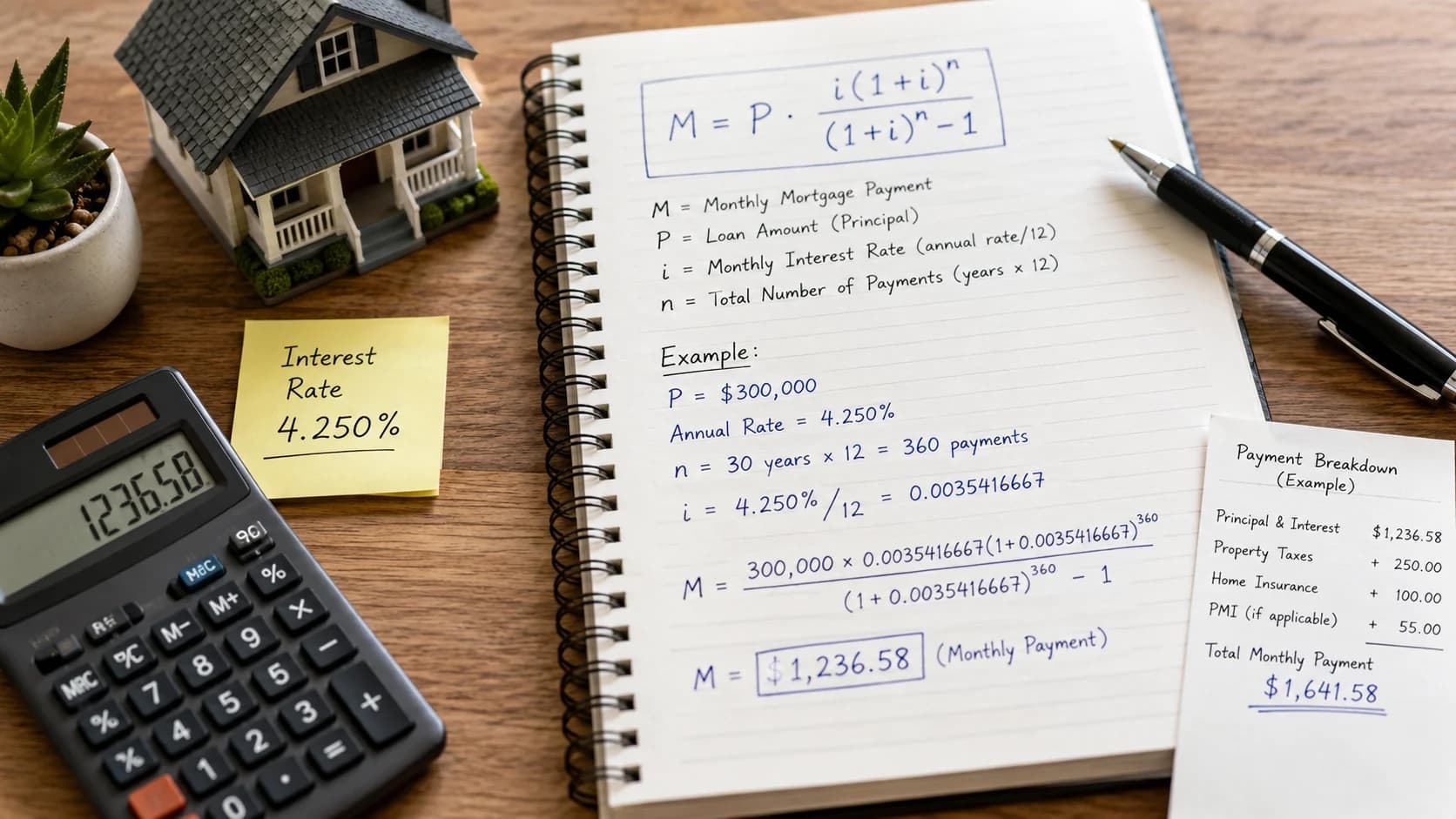
The standard formula for a fixed-rate mortgage monthly payment is:
M = P × [r(1+r)^n] / [(1+r)^n − 1]
- M = monthly mortgage payment (principal + interest only)
- P = principal loan amount (home price minus down payment)
- r = monthly interest rate (annual rate ÷ 12)
- n = total number of monthly payments (loan term in years × 12)
This formula is a present value of an annuity calculation. It finds the fixed monthly payment that, when compounded at rate r for n periods, exactly pays off a loan of P dollars. Banks use this same formula in every mortgage amortization schedule — there are no proprietary variations for conventional fixed-rate loans.
The fraction [r(1+r)^n] / [(1+r)^n − 1] is called the mortgage constant or capital recovery factor. For a 30-year mortgage at 7%, it equals approximately 0.006653. Multiply any principal by 0.006653 to get the monthly P&I payment at 7%/30 years.
Step-by-Step Example: $300,000 Loan at 7% for 30 Years
Step 1: Identify Your Variables
- P = $300,000
- Annual interest rate = 7.00%
- Loan term = 30 years
Step 2: Calculate the Monthly Rate (r)
Divide the annual rate by 12: r = 0.07 ÷ 12 = 0.0058333 (carry at least 7 decimal places to avoid rounding drift over 360 payments).
Step 3: Calculate the Total Number of Payments (n)
n = 30 years × 12 months = 360 payments
Step 4: Calculate (1 + r)^n
(1.0058333)^360 = 8.1157 (using natural logarithm: e^(360 × ln(1.0058333)) = e^2.09412 ≈ 8.1157)
Step 5: Apply the Formula
M = 300,000 × [0.0058333 × 8.1157] / [8.1157 − 1]
Numerator: 0.047342 | Denominator: 7.1157 | Fraction: 0.0066531
M = 300,000 × 0.0066531 = $1,995.91
Lenders round to $1,996/month. Over 360 payments, you pay $718,560 total — meaning $418,560 in interest on a $300,000 loan. Use our mortgage calculator to verify instantly.
Monthly Payments at Current Rates: $200K, $300K, and $400K
As of June 2026, the average 30-year fixed mortgage rate is approximately 6.85% (Freddie Mac Primary Mortgage Market Survey). The table below shows principal-and-interest payments across common loan sizes.
| Loan Amount | 6.5% / 30yr | 7.0% / 30yr | 7.5% / 30yr | 7.0% / 15yr |
|---|---|---|---|---|
| $200,000 | $1,264 | $1,331 | $1,399 | $1,797 |
| $300,000 | $1,896 | $1,996 | $2,098 | $2,696 |
| $400,000 | $2,528 | $2,661 | $2,797 | $3,595 |
| $500,000 | $3,160 | $3,327 | $3,496 | $4,494 |
These are principal and interest only. For the full picture including taxes and insurance on a $400K purchase, see our $400K mortgage true cost breakdown.
How Rate Changes Affect Your Payment
A 1% rate difference matters far more on a 30-year loan than shorter loans due to 360 compounding periods. Here is the full cost of each rate on a $300,000 loan:
| Rate | Monthly P&I | Total Paid (30yr) | Total Interest | vs. 6.0% |
|---|---|---|---|---|
| 6.0% | $1,799 | $647,514 | $347,514 | — |
| 6.5% | $1,896 | $682,560 | $382,560 | +$35,046 |
| 7.0% | $1,996 | $718,560 | $418,560 | +$71,046 |
| 7.5% | $2,098 | $755,280 | $455,280 | +$107,766 |
| 8.0% | $2,201 | $792,360 | $492,360 | +$144,846 |
Research by Freddie Mac found that borrowers who get five rate quotes save an average of 0.17% compared to those who take only one quote — about $10,000 in savings on a $300K loan over 30 years.
30-Year vs. 15-Year: What the Formula Reveals
| Scenario | Monthly P&I | Total Paid | Total Interest | Interest Savings |
|---|---|---|---|---|
| $300K at 7% / 30yr | $1,996 | $718,560 | $418,560 | — |
| $300K at 6.5% / 15yr | $2,614 | $470,520 | $170,520 | $248,040 |
| $300K at 6.75% / 15yr | $2,655 | $477,900 | $177,900 | $240,660 |
The 15-year monthly payment is 31% higher, but you save over $248,000 in interest and build equity twice as fast. For buyers who can afford the higher payment, the 15-year is almost always mathematically superior.
What the Formula Does NOT Include
The formula calculates principal and interest (P&I) only. Your actual PITI payment includes:
Property Taxes
The national average effective property tax rate is 0.99%, ranging from 0.27% in Hawaii to 2.47% in New Jersey (Tax Foundation, 2024). On a $350,000 home in Texas (1.68% effective rate), that adds $490/month.
Homeowners Insurance
Average homeowners insurance costs $1,759/year nationally in 2024 (Insurance Information Institute) — about $147/month. Coastal areas can run $3,000–$8,000/year.
PMI (if down payment below 20%)
PMI adds 0.46%–1.5% of your loan annually until you reach 80% LTV. On a $300,000 loan with 5% down, that is $109–$356/month. See our complete PMI guide for cancellation strategies.
Building an Amortization Schedule
Every monthly payment is split between interest and principal reduction. Interest is calculated on the remaining balance:
| Payment # | Payment | Principal | Interest | Remaining Balance |
|---|---|---|---|---|
| 1 | $1,996 | $246 | $1,750 | $299,754 |
| 2 | $1,996 | $247 | $1,748 | $299,507 |
| 12 | $1,996 | $261 | $1,735 | $296,762 |
| 180 (Year 15) | $1,996 | $519 | $1,477 | $252,983 |
| 359 | $1,996 | $1,984 | $12 | $1,984 |
| 360 | $1,995 | $1,984 | $11 | $0 |
In Year 1, only 12% of each payment reduces principal. By Year 15, you still owe $252,983 — after 15 years of payments. Extra payments in early years have outsized impact. Use our loan amortization calculator for the complete month-by-month schedule.
How to Use the Formula to Find Affordability
To find your maximum mortgage payment: take 28% of gross monthly income, subtract estimated taxes ($300–$500), insurance ($150), and PMI ($100–$300). The remainder is your max P&I.
Example: $8,000/month gross → max housing $2,240 → minus $600 in T+I+PMI → $1,640 max P&I → at 7%/30yr, that supports approximately $246,000 in loan principal. Use our home affordability calculator for your exact numbers.
Frequently Asked Questions
What is the mortgage payment formula for a fixed-rate loan?
The formula is M = P × [r(1+r)^n] / [(1+r)^n − 1], where M is the monthly payment, P is the loan principal, r is the monthly interest rate (annual rate divided by 12), and n is the total number of payments (years times 12). This calculates principal and interest only — property taxes, homeowners insurance, and PMI are added separately.
How do I calculate my mortgage payment without a calculator?
Use the mortgage constant for your rate. At 7%, the constant is approximately $6.65 per $1,000 borrowed per month. A $250,000 loan: $6.65 × 250 = $1,663/month. At 6.5%, the constant is $6.32/month per $1,000. These estimates are within $10 of the precise formula result.
Why does my payment stay the same but the principal/interest split change every month?
Because interest is calculated on your remaining balance, which decreases with each payment. In Month 1, your full $300,000 balance accrues interest. Each subsequent month, slightly less goes to interest and slightly more to principal. Over 30 years, this gradual shift completely reverses — by Month 359, almost nothing goes to interest.
How much does paying an extra $200/month toward principal save?
On a $300,000 loan at 7%, adding $200/month saves approximately $82,000 in interest and cuts the term from 30 years to about 23.5 years. Extra principal payments are most powerful early in the loan when your balance is highest.
Does the mortgage payment formula work for ARM loans?
The formula works for the fixed-rate period. Once the rate adjusts, recalculate using the new rate (r) applied to the remaining balance (P) and remaining payments (n). A 5/1 ARM fixed at 6.5% then adjusting to 8% would be recalculated in Month 61.
Further Reading
Related Calculators
Try these free calculators related to this article:
In-Depth Guides
Dive deeper with our comprehensive guides on this topic:
Frequently Asked Questions
Our Methodology
All mortgage payment formula content on CalculatorApp.me is reviewed by subject-matter experts, cross-referenced with official sources, and updated regularly for accuracy. Our formulas and data are verified against industry standards and government publications.
Jordan Hayes
Verified AuthorPersonal Finance Content Strategist
Jordan is a personal finance content strategist with 9+ years writing about mortgages, retirement, tax strategy, and budgeting. Every guide is cross-referenced with IRS publications, Federal Reserve data, and CFPB guidance to make complex calculations accessible. Editor at CalculatorApp.me.
Found this helpful? Share it!
Stay Updated
Get notified when we launch new calculators and features.
No spam. Unsubscribe anytime.