One Rep Max Calculator: How to Find Your 1RM and Use It to Train Smarter
Free Calculator
1RM Calculator
Table of Contents
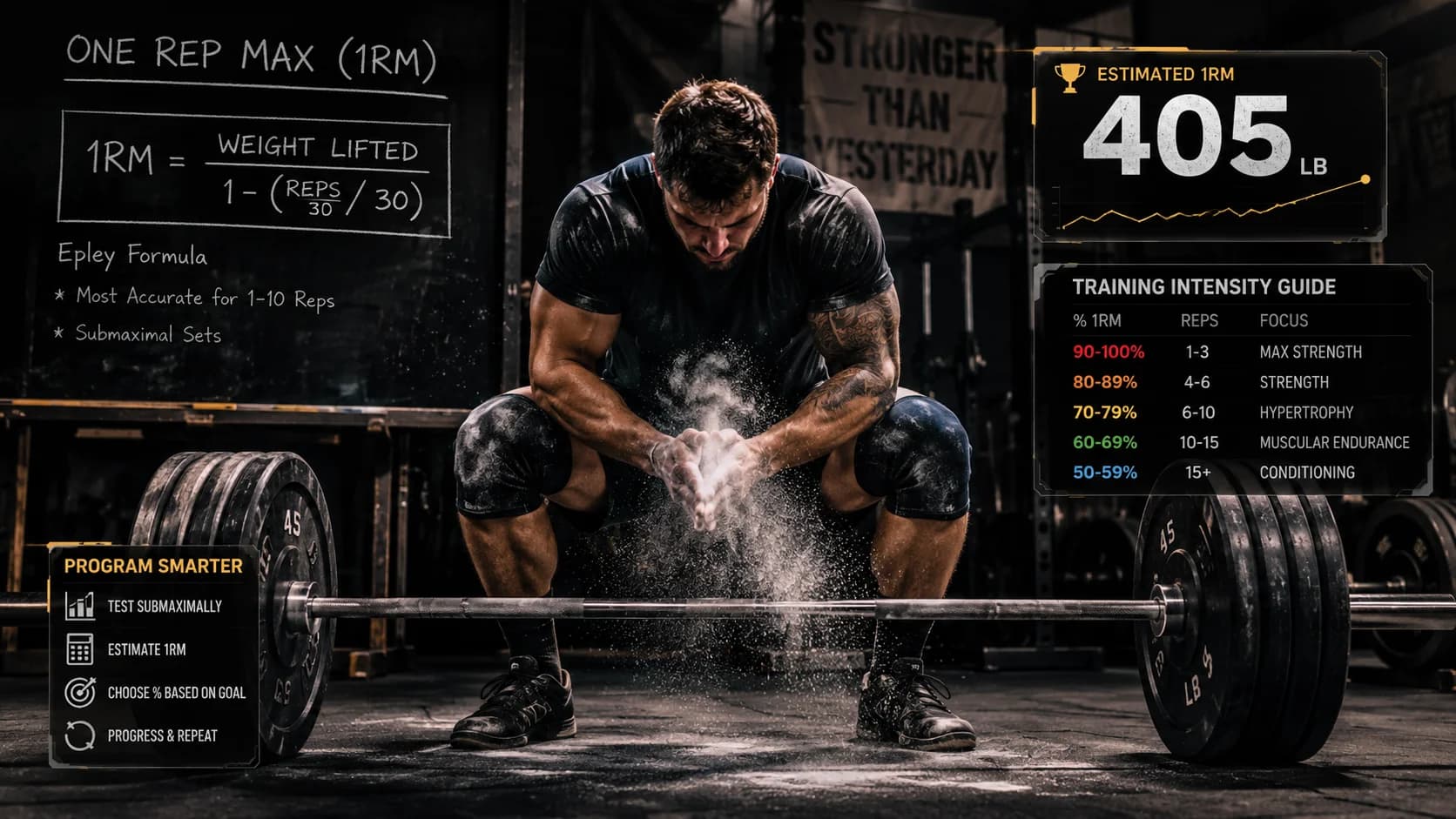
Bottom line: Your one rep max (1RM) is the maximum weight you can lift for a single repetition with proper form. You don't need to actually attempt a true maximum to find it — the Epley, Brzycki, and Lander formulas can estimate your 1RM from a submaximal set (e.g., 8 reps at 135 lbs). Once you know your 1RM, every major strength program — 5/3/1, Starting Strength percentages, powerlifting periodization — uses it to set your daily training weights. Use our one rep max calculator to find your 1RM from any rep-weight combination and automatically generate your training percentages.
Key Takeaways
- The most accurate 1RM estimates come from sets of 3–5 reps — formulas lose accuracy above 10 reps.
- The Epley formula (weight × (1 + reps/30)) is the most widely used and accurate for most lifters.
- Strength programs use percentages of 1RM: 70–75% for hypertrophy, 80–85% for strength, 90%+ for peaking.
- True 1RM testing carries injury risk — most athletes train from estimated 1RM and only test true max in competition.
- 1RM varies day to day based on sleep, stress, and nutrition — use a training max (90–95% of true 1RM) for daily programming.
- Use the 1RM calculator and then our workout generator to build a percentage-based program.
What Is One Rep Max (1RM)?
One rep max is the theoretical maximum weight you can lift for exactly one complete repetition with proper form for a given exercise. It is the standard unit of strength in powerlifting, Olympic weightlifting, and most serious strength training programs.
1RM is useful because it is relative — it scales to your body and allows direct comparison across different body weights and training backgrounds. A 185 lb squat 1RM for a 130 lb lifter represents greater relative strength than the same weight for a 200 lb lifter.
How to Estimate Your 1RM Without Actually Maxing Out
Performing a true 1RM test — loading the bar to your absolute maximum and attempting a single rep — carries meaningful injury risk and requires extensive warmup, a spotter, and significant recovery time. Most athletes instead estimate 1RM from submaximal sets using established prediction formulas.
The most accurate approach: perform a set of 3–5 reps at a challenging but controlled weight, note the weight and reps, then plug into a formula. Sets of 1–5 reps give the most accurate estimates. Above 10 reps, formula accuracy degrades significantly — a 15-rep set gives a poor 1RM estimate because muscular endurance increasingly contributes to performance vs. raw strength.
The Main 1RM Estimation Formulas
| Formula | Equation | Best For |
|---|---|---|
| Epley (1985) | w × (1 + r/30) | Most lifters; general use |
| Brzycki (1993) | w × (36 / (37 − r)) | Accurate for 1–10 reps |
| Lander (1985) | 100w / (101.3 − 2.67123 × r) | Alternative general formula |
| O'Conner et al. | w × (1 + 0.025r) | Conservative estimate |
w = weight lifted, r = number of reps performed
Example Calculation
You bench press 185 lbs for 5 reps. Using Epley: 185 × (1 + 5/30) = 185 × 1.167 = 215 lbs estimated 1RM. Using Brzycki: 185 × (36/32) = 185 × 1.125 = 208 lbs. The two formulas agree within about 3%, which is typical for sets of 3–6 reps.
Our one rep max calculator runs all major formulas simultaneously and shows the range of estimates so you can pick a conservative or moderate value for programming.

Training Percentages: How to Use Your 1RM
Once you know your 1RM, training weights are set as percentages. Here are the standard percentage zones and their training effects:
| % of 1RM | Typical Rep Range | Primary Training Effect | Example: 300 lb squat 1RM |
|---|---|---|---|
| 50–60% | 12–20+ | Muscular endurance, warmup | 150–180 lbs |
| 60–70% | 10–15 | Hypertrophy (volume) | 180–210 lbs |
| 70–80% | 6–12 | Hypertrophy + strength | 210–240 lbs |
| 80–85% | 4–6 | Strength | 240–255 lbs |
| 85–92% | 2–4 | Maximal strength | 255–276 lbs |
| 92–97% | 1–2 | Peaking / competition prep | 276–291 lbs |
| 97–100%+ | 1 | True max effort / testing | 291–300+ lbs |
Training Max vs. True 1RM
Most percentage-based programs (notably Jim Wendler's 5/3/1) recommend using a training max of 85–90% of your true 1RM as the basis for daily programming, rather than your actual maximum.
Why: Your true 1RM represents a perfect-day, peak-effort performance. Training daily at 90–95% of that creates excessive fatigue and injury risk. Using 85–90% as the base ensures you can complete all programmed sets with quality form, progressing consistently over weeks and months rather than grinding through maximal efforts each session.
For a lifter with a 300 lb squat 1RM: training max = 270 lbs (90%). Week 1 of 5/3/1 uses 65%, 75%, 85% of 270 lbs — not 300 lbs. This seems conservative but accumulates enormous volume and produces steady, sustainable progress.
How Often Should You Test Your 1RM?
For recreational and intermediate lifters, formal 1RM testing every 8–16 weeks is sufficient. Most good programs include built-in 1RM re-estimation at the end of training cycles. Signs it is time to re-test or re-estimate:
- Your submaximal sets feel noticeably easier at weights that were previously challenging
- You have completed 2–3 full training cycles without updating your training max
- You have had a major training change (new program, post-injury return)
For powerlifters peaking for competition, 1RM testing and near-max singles are part of the structured peaking block in the 2–4 weeks before the meet.
1RM by Exercise: Typical Strength Standards
| Exercise | Beginner (male) | Intermediate (male) | Advanced (male) | Elite (male) |
|---|---|---|---|---|
| Squat | Bodyweight | 1.5× BW | 2× BW | 2.5–3× BW |
| Deadlift | 1× BW | 1.75× BW | 2.25× BW | 3× BW+ |
| Bench Press | 0.75× BW | 1.25× BW | 1.5× BW | 2× BW+ |
| Overhead Press | 0.4× BW | 0.7× BW | 1× BW | 1.3× BW+ |
BW = bodyweight. Women's standards are typically 60–75% of the male values for the same level.
Frequently Asked Questions About 1RM
Is it safe to test your true 1RM?
With proper preparation, yes — but it carries more risk than submaximal training. Requirements for a safe 1RM test: extensive warmup (build to the working weight over 4–6 progressively heavier sets), a competent spotter (for bench press and squat), proper form throughout all warmup sets, and adequate recovery in the preceding days. Do not test 1RM when fatigued, within 48 hours of a heavy training session, or if you are new to the exercise. Most intermediate and advanced lifters can safely test 1RM; most beginners should stick to formula estimates.
Why does my estimated 1RM differ from my actual max?
Formula estimates become less accurate above 5 reps because muscular endurance increasingly contributes to the rep count. Someone with high muscular endurance (a distance runner, for example) may perform 12+ reps at 70% of 1RM, making their estimated 1RM significantly higher than their actual max. For best accuracy, use 3–5 rep sets as your estimation input.
Should beginners program from 1RM?
Generally no. Beginners benefit most from linear progression — adding small amounts of weight to each session regardless of percentages (programs like Starting Strength or StrongLifts). 1RM-based percentage programming becomes valuable once linear gains slow and more sophisticated periodization is needed, typically after 6–18 months of consistent training.
How does body weight affect 1RM?
Heavier athletes generally lift more total weight in absolute terms; lighter athletes often lift more relative to their bodyweight. Powerlifting competitions account for this with weight classes and Wilks/IPF GL coefficient scoring — a formula that normalizes lifts across body weights for fair comparison.
Related Calculators
Try these free calculators related to this article:
In-Depth Guides
Dive deeper with our comprehensive guides on this topic:
Frequently Asked Questions
Our Methodology
All one rep max content on CalculatorApp.me is reviewed by subject-matter experts, cross-referenced with official sources, and updated regularly for accuracy. Our formulas and data are verified against industry standards and government publications.
Jordan Hayes
Verified AuthorPersonal Finance Content Strategist
Jordan is a personal finance content strategist with 9+ years writing about mortgages, retirement, tax strategy, and budgeting. Every guide is cross-referenced with IRS publications, Federal Reserve data, and CFPB guidance to make complex calculations accessible. Editor at CalculatorApp.me.
Found this helpful? Share it!
Stay Updated
Get notified when we launch new calculators and features.
No spam. Unsubscribe anytime.