Healthy Body Fat Percentage by Age and Sex: The Complete 2026 Guide
Free Calculator
Percentage Calculator
Table of Contents
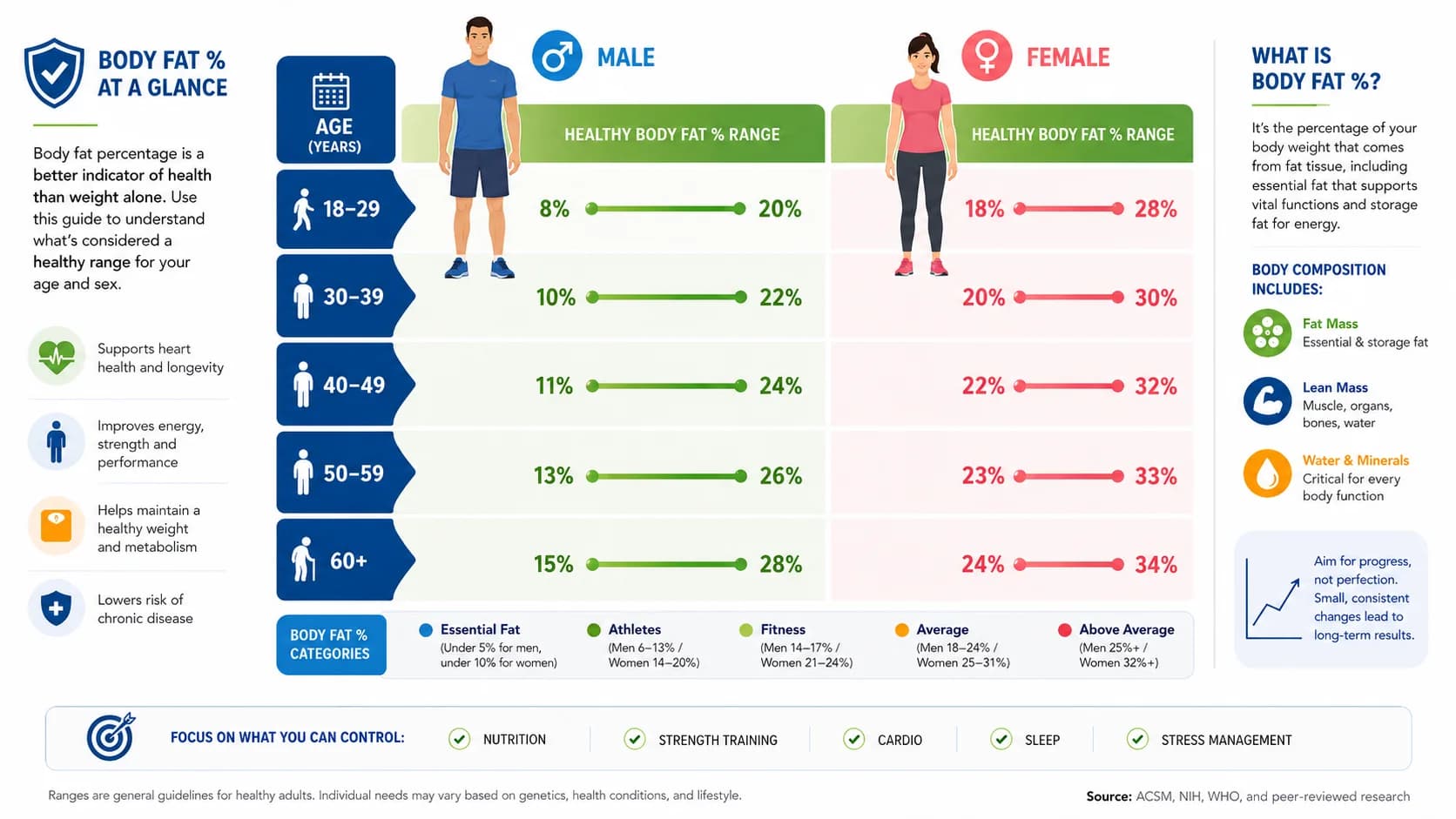
Bottom line: A healthy body fat percentage for women is 21–33% and for men 8–19% — though the ideal range shifts with age. Body fat percentage is more meaningful than BMI because it distinguishes between fat mass and lean mass (muscle, bone, water). An athlete at 200 lbs and 12% body fat and a sedentary person at 200 lbs and 30% body fat have the same weight and similar BMI but dramatically different health profiles. Use our free body fat calculator to estimate your percentage from circumference measurements.
Key Takeaways
- Body fat percentage measures fat as a share of total body weight — a better health predictor than scale weight alone.
- Women need 10–13% essential fat; men need 2–5% — below these levels, organ and hormonal function are compromised.
- The American Council on Exercise (ACE) defines "fitness" as 14–17% for men and 21–24% for women.
- Visceral fat (around organs) is more dangerous than subcutaneous fat (under skin) — even lean people can have high visceral fat.
- DEXA scan is the gold-standard measurement; skinfold calipers and the Navy circumference method are accurate enough for tracking progress at home.
- Use the body fat calculator + BMI calculator together for a complete picture of your body composition.
Body Fat Percentage Ranges: What's Healthy?
The American Council on Exercise (ACE) publishes the most widely cited body fat classification table. These ranges account for essential fat — the minimum amount needed for basic physiological function — plus storage fat.
| Category | Women | Men |
|---|---|---|
| Essential Fat | 10–13% | 2–5% |
| Athletes | 14–20% | 6–13% |
| Fitness | 21–24% | 14–17% |
| Acceptable | 25–31% | 18–24% |
| Obese | 32%+ | 25%+ |
Why do women have higher healthy ranges? Women require more essential fat to support hormonal function, reproductive health, and pregnancy. Dropping below 14–16% body fat disrupts estrogen production, which can cause menstrual irregularities, bone density loss, and fertility problems — a condition known as the female athlete triad.
How Body Fat Changes With Age
Body fat percentage naturally increases with age even when body weight stays the same — because lean muscle mass declines (sarcopenia) starting around age 30 at roughly 3–5% per decade. This means "healthy" ranges shift upward slightly as you age.
| Age Range | Healthy % — Women | Healthy % — Men |
|---|---|---|
| 20–29 | 16–23% | 7–17% |
| 30–39 | 17–24% | 12–21% |
| 40–49 | 20–27% | 14–23% |
| 50–59 | 22–30% | 16–24% |
| 60+ | 22–31% | 17–25% |
The takeaway: a 55-year-old woman at 28% body fat is in a healthy range, while the same percentage in a 22-year-old woman would be classified as "acceptable" but not optimal. Always interpret your percentage in context of your age. Our body fat calculator factors in age automatically.
Body Fat vs. BMI: Which Metric Matters More?
BMI (body mass index) divides weight by height squared. It is useful at the population level but misleading for individuals because it cannot distinguish fat from muscle. A 180 lb person who is 5'10" has a BMI of 25.8 ("overweight") regardless of whether they are a lean, muscular athlete or a sedentary person with 30% body fat.
Body fat percentage solves this by directly measuring what you actually want to know: how much of your body is fat. Studies consistently show body fat percentage is a better predictor of metabolic syndrome, insulin resistance, and cardiovascular risk than BMI alone.
That said, BMI is not useless — it identifies probable obesity at scale without expensive testing. The optimal approach is to use both metrics together: check your BMI with our BMI calculator, then cross-check with body fat percentage. For a full comparison of both metrics, see our guide on BMI vs. body fat percentage.
Visceral Fat vs. Subcutaneous Fat
Not all fat is equal. Body fat exists in two main types:
- Subcutaneous fat — stored under the skin. This is the fat you can pinch. While excess subcutaneous fat is unhealthy, it is metabolically less dangerous than visceral fat.
- Visceral fat — stored around internal organs (liver, pancreas, intestines). Even people with a "normal" total body fat percentage can carry dangerous levels of visceral fat. It is metabolically active, secreting inflammatory compounds linked to type 2 diabetes, heart disease, and certain cancers.
Visceral fat is strongly correlated with waist circumference. Health guidelines use waist circumference as a proxy for visceral fat risk:
- Men: Waist >40 inches (102 cm) = elevated visceral fat risk
- Women: Waist >35 inches (88 cm) = elevated visceral fat risk
Someone can have a BMI in the "normal" range and a body fat percentage in the "acceptable" range but still carry dangerous visceral fat if their waist-to-height ratio is high. This is called "normal-weight obesity" or "metabolically obese normal weight" (MONW).
How to Measure Body Fat Percentage
Methods range from highly accurate (and expensive) to practical (and slightly less precise):
| Method | Accuracy | Cost | Accessibility |
|---|---|---|---|
| DEXA Scan | ±1–2% | $50–$150 | Requires medical facility |
| Hydrostatic Weighing | ±1–3% | $30–$75 | Requires university/lab |
| Air Displacement (Bod Pod) | ±2–3% | $45–$75 | Requires specialized equipment |
| Skinfold Calipers (7-site) | ±3–4% | $10–$30 | Requires trained technician |
| Navy Circumference Method | ±3–4% | Free | Tape measure only |
| Bioelectrical Impedance (BIA) | ±3–8% | $20–$200 | Home scales/handheld devices |
| BMI-based estimate | ±5–8% | Free | Weight + height only |
The Navy Circumference Method uses neck, waist, and hip measurements to estimate body fat — it is the most practical accurate method for home use and is what our body fat calculator uses. For DEXA, check if a university wellness center, sports medicine clinic, or Body Spec near you offers scans. DEXA is the most reliable single-number reading.
BIA scales (including smart scales from Withings, Garmin, and RENPHO) are convenient but highly variable — hydration level, food in your stomach, and skin temperature all affect readings. Use them for trending direction, not absolute numbers.
How to Reduce Body Fat Percentage
Reducing body fat is distinct from simply losing weight. The goal is to lose fat while preserving (or building) lean muscle mass — which requires both a calorie deficit and adequate protein intake.
- Create a moderate calorie deficit. A deficit of 300–500 calories per day produces 0.5–1 lb of fat loss per week without triggering muscle-preserving hormonal adaptation. Use our calorie deficit calculator to find your specific target. Aggressive deficits (>1,000 calories/day) cause significant muscle loss, which worsens body fat percentage even as weight drops.
- Eat adequate protein. Research supports 0.7–1.0g of protein per pound of body weight during fat loss phases to preserve lean mass. Our protein calculator gives you a personalized target based on weight and activity level.
- Do resistance training. Muscle is metabolically active tissue — building or maintaining it keeps your metabolic rate elevated and improves body composition even without additional weight loss. See our workout generator for a structured program.
- Prioritize sleep. Sleep deprivation elevates cortisol and ghrelin, driving both fat storage and appetite. Research shows sleeping fewer than 6 hours per night significantly impairs fat loss outcomes even on identical calorie deficits. Check your optimal sleep timing with our sleep calculator.
- Manage visceral fat specifically through aerobic exercise (which targets visceral fat preferentially over subcutaneous fat), reduced alcohol consumption, and stress management.
Frequently Asked Questions About Body Fat Percentage
What body fat percentage shows abs?
Visible abs (abdominal definition) typically appear at 10–14% body fat in men and 16–20% in women. The exact threshold depends on fat distribution genetics — some people show ab definition at 15% (men) or 22% (women) due to lower abdominal fat storage. A six-pack is primarily a function of body fat percentage, not ab muscle development.
Is 30% body fat bad for a woman?
30% body fat in a woman falls in the "acceptable" range per ACE guidelines, and within healthy norms for women over 50. For women in their 20s–40s, 30% is borderline high and associated with mildly elevated metabolic risk. It is not classified as obese (which begins at 32% for women) but represents an opportunity for improvement through diet and exercise.
Can you have a normal BMI but high body fat?
Yes — this is called "normal-weight obesity" or TOFI (Thin Outside, Fat Inside). A person can have a BMI of 22 (healthy range) while carrying 30%+ body fat due to very low muscle mass. This pattern is more common in sedentary individuals who have never built significant muscle. DEXA scan is the only reliable way to identify this pattern.
How fast can you realistically lower body fat percentage?
A realistic rate of fat loss on a well-structured diet and exercise program is 0.5–1% body fat per month. Someone at 28% body fat targeting 22% is looking at a 6–12 month process. Faster rates are possible in the early weeks but rarely sustainable without significant muscle loss.
Does body fat percentage affect athletic performance?
Yes, significantly. For weight-bearing sports (running, cycling), lower body fat improves power-to-weight ratio. Elite marathon runners are typically 5–12% (men) or 12–18% (women). However, being too lean impairs performance — essential fat stores support hormone production, immune function, and energy availability. Very low body fat in endurance athletes is associated with RED-S (Relative Energy Deficiency in Sport).
Related Calculators
Try these free calculators related to this article:
In-Depth Guides
Dive deeper with our comprehensive guides on this topic:
Frequently Asked Questions
Our Methodology
All body fat content on CalculatorApp.me is reviewed by subject-matter experts, cross-referenced with official sources, and updated regularly for accuracy. Our formulas and data are verified against industry standards and government publications.
Jordan Hayes
Verified AuthorPersonal Finance Content Strategist
Jordan is a personal finance content strategist with 9+ years writing about mortgages, retirement, tax strategy, and budgeting. Every guide is cross-referenced with IRS publications, Federal Reserve data, and CFPB guidance to make complex calculations accessible. Editor at CalculatorApp.me.
Found this helpful? Share it!
Stay Updated
Get notified when we launch new calculators and features.
No spam. Unsubscribe anytime.