BMI by Age: Why Your Ideal BMI Changes After 30 (2026 Guide)
Free Calculator
BMI Calculator
Table of Contents
The Problem With One BMI Number for Every Age
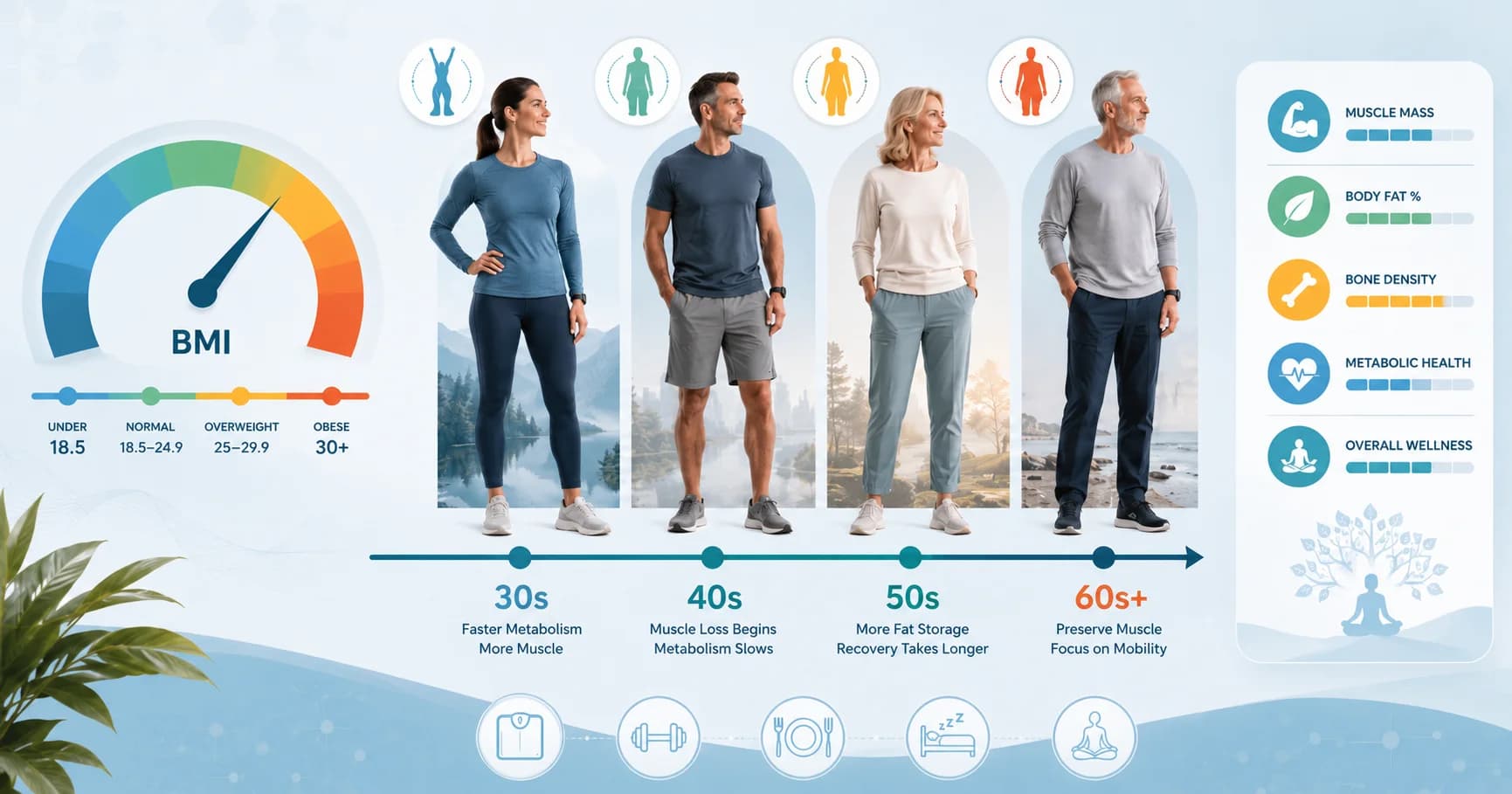
The standard BMI chart gives you four categories — underweight, normal (18.5–24.9), overweight (25–29.9), and obese (30+) — and applies them identically to a 22-year-old college student and a 72-year-old retiree. Research consistently shows this is wrong.
Body composition changes fundamentally with age. After 30, adults naturally lose muscle mass and gain fat — a process called sarcopenia — even if the number on the scale stays the same. This means a BMI of 24 looks very different at 25 than it does at 55.
In this guide we walk through what the research recommends for BMI by decade, why the standard thresholds miss the mark, and how the new Trefethen BMI formula partially corrects this problem.
How BMI Changes With Age: What the Research Shows
A landmark 2012 study in the American Journal of Clinical Nutrition analysed 32 studies covering 197,940 adults and found that slightly higher BMI values in older adults were associated with lower all-cause mortality — the opposite of what the standard chart implies.
The "obesity paradox" is well-documented in people over 65: moderate overweight (BMI 25–29.9) is associated with better survival outcomes than the "normal" range. Meanwhile, in younger adults, a BMI above 27 begins to predict metabolic risk.
Healthy BMI Ranges by Age Group (Research-Based)
These ranges are drawn from the Baltimore Longitudinal Study of Aging, the US NHANES dataset, and European epidemiological studies. They are not the official WHO thresholds — they reflect what the evidence says about health outcomes at each life stage.
Ages 18–29
- Optimal range: 18.5 – 24.9
- Why: At this age, lean mass is near its peak. High BMI in young adults strongly correlates with metabolic risk. The standard chart is most accurate here.
- Watch for: BMI below 18.5 in young women is a risk factor for bone density loss and hormonal disruption.
Ages 30–39
- Optimal range: 19.0 – 25.9
- Why: Muscle mass begins declining around age 30 at roughly 3–8% per decade. A BMI at the high end of "normal" may reflect muscle, not fat.
- Watch for: Waist circumference becomes a better predictor of metabolic health than BMI alone. Men above 40 inches, women above 35 inches face elevated cardiovascular risk regardless of BMI.
Ages 40–49
- Optimal range: 20.0 – 27.9
- Why: The shift from subcutaneous to visceral fat accelerates in the 40s. BMI can look "normal" while visceral fat (the dangerous kind) accumulates. Body fat percentage becomes more informative.
- Watch for: Women in perimenopause (typically 40–50) experience accelerated fat redistribution. Waist-to-hip ratio is a better tool than BMI in this decade.
Ages 50–59
- Optimal range: 22.0 – 28.9
- Why: Bone density begins to decline in both men and women. A BMI slightly higher than the textbook "normal" provides protective bone loading and energy reserves during illness.
- Watch for: In postmenopausal women, BMI below 21 is associated with increased fracture risk. A BMI of 22–26 is associated with the best long-term outcomes in this group.
Ages 60–69
- Optimal range: 23.0 – 29.9
- Why: The "obesity paradox" begins to clearly operate. Adults in their 60s with BMI 25–29.9 ("overweight" by standard charts) consistently show lower mortality in long-term studies than those in the "normal" range.
- Watch for: Unintentional weight loss of more than 5% over 6–12 months is a significant health warning at this age, even if the resulting BMI looks better on a chart.
Ages 70+
- Optimal range: 24.0 – 30.9
- Why: At 70+, sarcopenia is a major health threat. Maintaining higher body weight preserves the muscle mass and fat reserves needed to survive hospitalisation, infection, and surgery. A BMI of 27–30 is associated with the lowest mortality in multiple large cohort studies of older adults.
- Watch for: For adults over 70, physical function (can you get up from a chair without arms?) is a more meaningful health marker than BMI. Low muscle strength (dynapenia) predicts hospitalisation better than BMI does.
BMI for Women vs Men at the Same Age: Does It Differ?
Women naturally carry 6–11% more body fat than men at the same BMI. This is physiologically normal — it supports reproductive function and hormonal health. This means a woman with a BMI of 24 and a man with a BMI of 24 have meaningfully different body compositions.
However, the standard BMI thresholds are the same for both sexes. Some researchers argue women's "healthy" BMI ceiling should sit slightly higher (around 25.5–26) to avoid pathologising healthy female body fat. The Trefethen formula does not solve this — it corrects for height bias but uses the same thresholds for men and women.
How the New Trefethen BMI Formula Affects Age-Based Readings
Oxford mathematician Nick Trefethen's revised formula — BMI = 1.3 × weight(kg) / height(m)²·⁵ — corrects for a systematic bias in the original formula that overestimates BMI for tall people and underestimates it for short people.
For age-based BMI interpretation, this matters most in older adults who have lost height due to vertebral compression. A 70-year-old woman who was 5'6" at 25 may now measure 5'3". The traditional formula penalises this height loss by returning a higher BMI, even if her weight is unchanged. The Trefethen formula softens this effect.
Try the New BMI Formula Calculator to see how your reading changes between the standard and Trefethen methods.
Better Alternatives to BMI for Tracking Health by Age
BMI is a screening tool, not a diagnostic one. At every age — but especially over 40 — these measures add important context:
- Waist circumference: Elevated risk starts at 40 in. (102 cm) for men, 35 in. (88 cm) for women
- Waist-to-height ratio: Values over 0.5 indicate abdominal obesity regardless of BMI
- Body fat percentage: Measured by DEXA scan, bioelectrical impedance, or skinfold calipers — more precise than BMI
- Grip strength: A strong predictor of all-cause mortality, especially in adults 60+
- VO₂ max (cardiorespiratory fitness): Predicts longevity better than BMI in multiple studies
Use Our Calculators to Track Health by Age
BMI is one data point. Use it alongside these tools for a fuller picture:
- BMI Calculator — Standard and Trefethen formula
- Body Fat Percentage Calculator — More precise than BMI
- TDEE Calculator — Your true daily calorie need by age and activity
- Ideal Weight Calculator — Multiple formulas compared
Key Takeaways
- Standard BMI thresholds (18.5–24.9 normal) were designed for population-level screening, not individual health assessment
- In adults over 60, a BMI of 25–30 is associated with better health outcomes than the "normal" range
- Women carry more body fat than men at the same BMI — this is normal, not unhealthy
- After 40, waist circumference and body fat percentage are more informative than BMI alone
- Unintentional weight loss matters more than the BMI number — track the trend, not just the snapshot
Related: Next Steps in Your Health Journey
- The New BMI Formula (Trefethen) — Understand why the standard BMI formula is biased toward tall people, and how the Oxford formula corrects it.
- TDEE Calculator Guide — Use your BMI reading as a starting point, then calculate your real daily calorie burn.
- How to Calculate BMI — Full formula walkthrough with metric and imperial examples.
Related Calculators
Try these free calculators related to this article:
In-Depth Guides
Dive deeper with our comprehensive guides on this topic:
Frequently Asked Questions
Our Methodology
All health content on CalculatorApp.me is reviewed by subject-matter experts, cross-referenced with official sources, and updated regularly for accuracy. Our formulas and data are verified against industry standards and government publications.
Jordan Hayes
Verified AuthorPersonal Finance Content Strategist
Jordan is a personal finance content strategist with 9+ years writing about mortgages, retirement, tax strategy, and budgeting. Every guide is cross-referenced with IRS publications, Federal Reserve data, and CFPB guidance to make complex calculations accessible. Editor at CalculatorApp.me.
Found this helpful? Share it!
Stay Updated
Get notified when we launch new calculators and features.
No spam. Unsubscribe anytime.