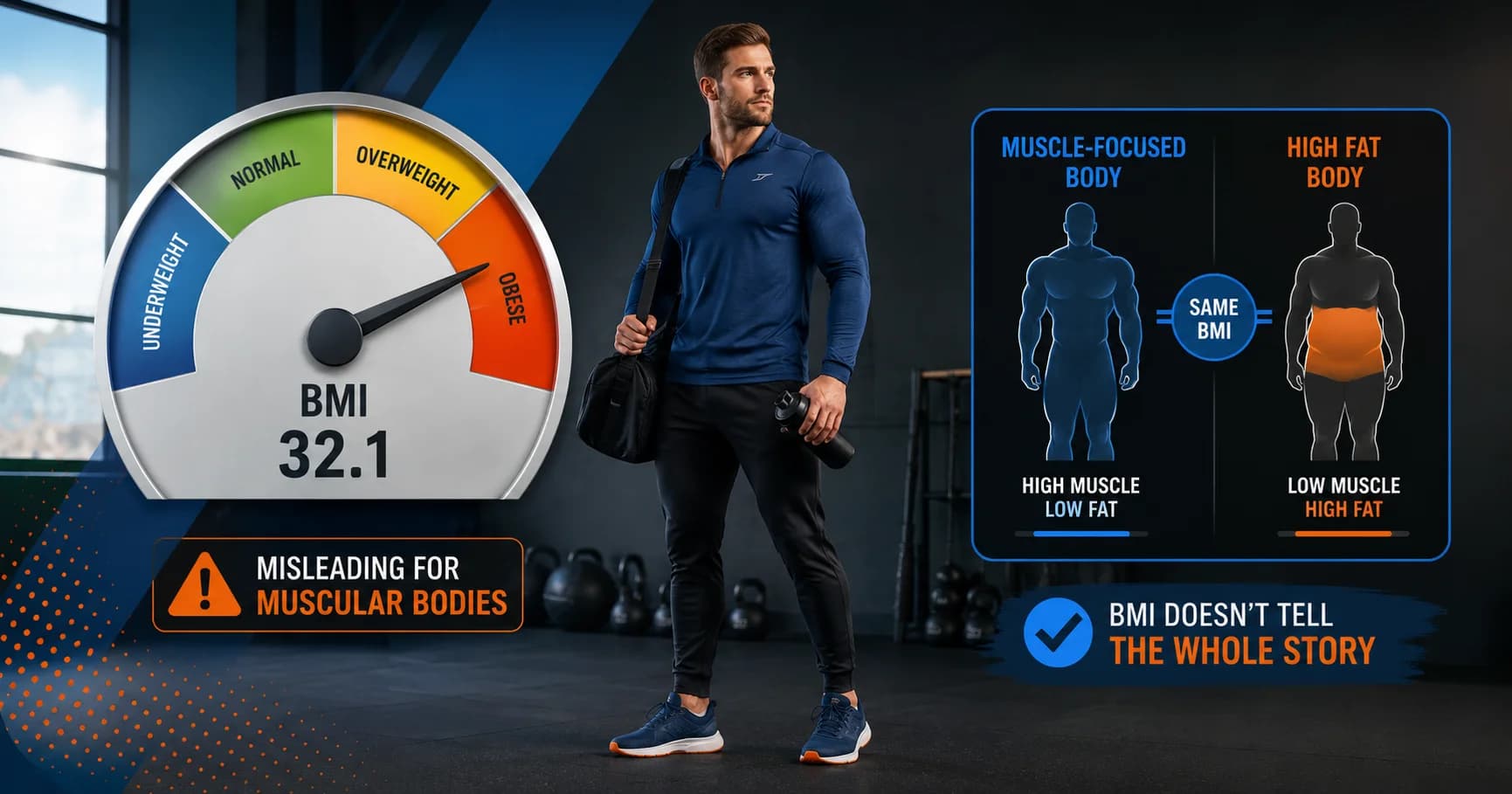
BMI for Athletes: Why the Standard Formula Fails Muscular Bodies
Free Calculator
BMI Calculator
Table of Contents
The Fundamental Problem: BMI Cannot Tell Fat from Muscle
BMI (Body Mass Index) divides weight by height squared. It has no way to distinguish between a kilogram of fat and a kilogram of muscle. For the general sedentary population, this is an acceptable shortcut — most people with high BMI do have excess fat. But for athletes and regularly trained individuals, this assumption breaks down completely.
For BMI fundamentals, categories, and alternative body-composition metrics, see our complete BMI & Health Metrics Guide.
A 180 cm (5'11") male rugby player weighing 95 kg has a BMI of 29.3 — solidly in the "overweight" range, approaching "obese." If that player has 8–12% body fat (which is lean even by athletic standards), the BMI number is meaningless as a health indicator. Yet it is the number that appears in his medical record.
Try the new Trefethen BMI formula to see if it makes a difference for your reading. (Spoiler: it helps with height bias, but not the muscle-mass problem.)
How Common Is BMI Misclassification in Athletes?
Research has consistently documented the scale of the problem:
- A 2005 study in the Journal of the American Medical Association found that 28.6% of NFL players were classified as "obese" by BMI, yet had body fat percentages well within the healthy athletic range.
- A 2012 study of Division I collegiate athletes found that 40% of male athletes were classified as "overweight" or "obese" despite having body fat levels equivalent to non-obese non-athletes.
- Among female athletes, BMI frequently underestimates health risks: gymnasts and endurance runners can have a BMI in the normal range while suffering from low energy availability and bone density loss (the Female Athlete Triad).
Which Sports Are Most Affected?
| Sport Type | BMI Direction of Error | Why |
|---|---|---|
| Rugby, American football, powerlifting, bodybuilding | BMI overestimates fatness | High muscle mass drives weight up disproportionately |
| Gymnastics, distance running, rowing (lightweight) | BMI underestimates fatness | Low muscle mass can hide unhealthy low body fat or bone density loss |
| Swimming, cycling, team ball sports | Usually overestimates fatness by 1–3 BMI units | Moderate muscle mass increases |
| Golf, cricket, bowling | BMI reasonably accurate | Limited muscle mass development |
Better Alternatives to BMI for Athletes
1. Body Fat Percentage
The gold standard. Body fat percentage directly measures the proportion of fat mass to total mass, ignoring the fat vs. muscle confusion that breaks BMI.
| Category | Men | Women |
|---|---|---|
| Essential fat (minimum for health) | 2–5% | 10–13% |
| Athletic | 6–13% | 14–20% |
| Fitness | 14–17% | 21–24% |
| Acceptable | 18–24% | 25–31% |
| Obese | 25%+ | 32%+ |
Measurement methods in order of accuracy: DEXA scan (gold standard), underwater weighing (hydrostatic), air displacement plethysmography (Bod Pod), skinfold calipers (accurate when done correctly), bioelectrical impedance analysis (convenient but variable). Use our Body Fat Calculator for an estimate from measurements.
2. Waist-to-Height Ratio
Research increasingly supports waist-to-height ratio (WHtR) as a better predictor of cardiometabolic risk than BMI — and it is not fooled by muscle mass because the waist does not grow proportionally with muscle development.
Formula: WHtR = Waist circumference ÷ Height (both in same unit)
Risk thresholds: under 0.40 = underweight risk; 0.40–0.50 = healthy; 0.50–0.60 = increased risk; over 0.60 = high risk.
An athlete with a BMI of 29 and a waist-to-height ratio of 0.44 is in the healthy zone — the BMI is misleading, the WHtR is not.
3. Fat-Free Mass Index (FFMI)
FFMI separates the lean mass component of BMI from the fat component, making it the most accurate single index for assessing muscularity relative to height.
Formula: FFMI = (Weight × (1 − body fat%)) ÷ height(m)²
Natural (non-enhanced) FFMI values above 25 in men and 22 in women are considered exceptional. Values above 27–28 in men are rarely achievable without performance-enhancing drugs. This makes FFMI a useful reference point for trained individuals.
How to Interpret Your BMI if You Train Regularly
If you exercise 3+ times per week and are in a sport with meaningful strength or power demands, apply these adjustments to your BMI reading:
- Add ~1–2 BMI points of "error allowance" for recreational gym-goers (3–5 hrs lifting per week)
- Add ~2–4 BMI points for competitive amateur athletes in strength or power sports
- Add ~4–8 BMI points for advanced or elite strength athletes (the player-who-reads-obese scenario)
- Subtract 1–3 BMI points if you are a low-weight endurance athlete — your "normal" BMI may hide low bone density or low energy availability
The most reliable approach: pair your BMI reading with body fat percentage (even a rough skinfold estimate), waist circumference, and performance metrics (strength, endurance benchmarks). No single number tells the full story.
For Female Athletes: The Other Direction of Error
Female athletes face a different BMI problem. The Female Athlete Triad — low energy availability, menstrual dysfunction, and low bone mineral density — can exist alongside a "normal" BMI. Distance runners and gymnasts in particular may be metabolically and hormonally compromised despite appearing healthy by BMI standards.
Warning signs in female athletes that BMI misses: absent or irregular periods, stress fractures, fatigue disproportionate to training load, difficulty maintaining weight despite high calorie intake.
Use These Tools for a Complete Athletic Health Picture
- BMI Calculator — Standard and Trefethen formula
- Body Fat Percentage Calculator — More accurate for athletes
- TDEE Calculator — Calorie needs scale significantly with athletic training volume
- Protein Calculator — Athletes need 1.6–2.2 g/kg, not the RDA of 0.8 g/kg
- One Rep Max Calculator — Track strength progress independently of weight
Related Calculators
Try these free calculators related to this article:
In-Depth Guides
Dive deeper with our comprehensive guides on this topic:
Frequently Asked Questions
Our Methodology
All health content on CalculatorApp.me is reviewed by subject-matter experts, cross-referenced with official sources, and updated regularly for accuracy. Our formulas and data are verified against industry standards and government publications.
Jordan Hayes
Verified AuthorPersonal Finance Content Strategist
Jordan is a personal finance content strategist with 9+ years writing about mortgages, retirement, tax strategy, and budgeting. Every guide is cross-referenced with IRS publications, Federal Reserve data, and CFPB guidance to make complex calculations accessible. Editor at CalculatorApp.me.
Found this helpful? Share it!
Stay Updated
Get notified when we launch new calculators and features.
No spam. Unsubscribe anytime.