New BMI vs Old BMI: Which Formula Should You Use in 2026?
Free Calculator
BMI Calculator
Table of Contents
If you've heard that BMI has been updated, you're not wrong — but the story is more nuanced than most headlines suggest. The "new BMI" (or Trefethen BMI) changes a single number in the formula: the height exponent goes from 2 to 2.5. That small change can shift your BMI by 1–3 points if you're significantly taller or shorter than average. This article shows you exactly when the difference matters — and when it doesn't.
New to BMI? Start with our complete BMI & Health Metrics Guide for formulas, category charts, and better alternatives.
New to the topic? Start with our full Trefethen new BMI guide for the math and evidence behind the change, or brush up on the basics in how to calculate BMI.
Key Takeaways
The standard BMI uses height² (squared); the new Trefethen BMI uses height^2.5
For people of average height (5'4"–5'11"), both formulas produce nearly identical results
Tall adults (6'2"+) typically score 1–3 points lower on the new BMI — often shifting from "overweight" to "healthy"
Short adults (under 5'2") typically score 1–2 points higher on the new BMI
No major health organization (WHO, CDC, NHS) has officially adopted the new formula as of 2026
What Is the Standard BMI Formula?
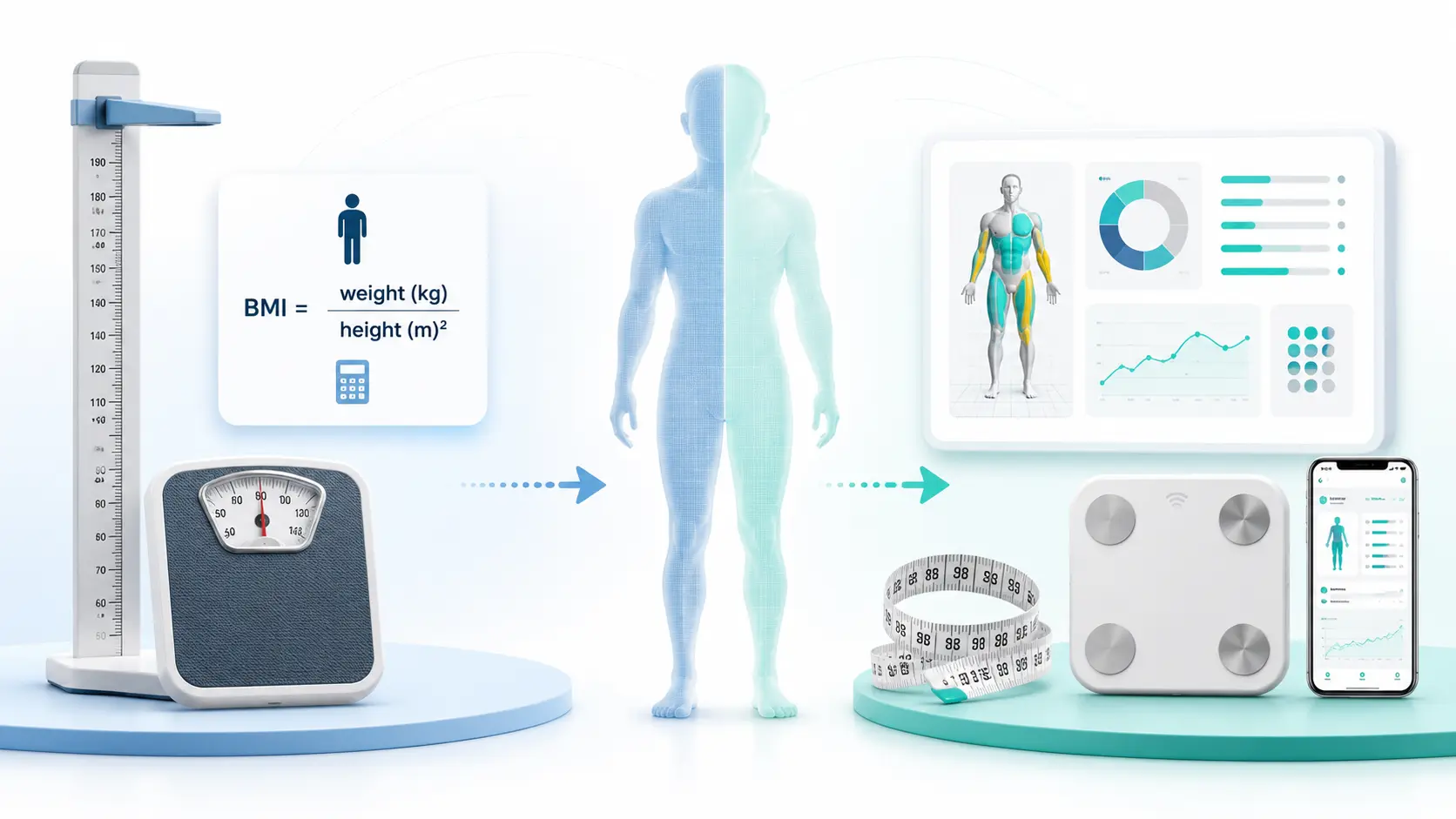
The standard Body Mass Index formula was developed by Belgian mathematician Adolphe Quetelet in the 1830s — nearly 200 years ago. It divides your weight in kilograms by the square of your height in metres:
Standard BMI = weight (kg) ÷ height (m)²
Imperial: BMI = 703 × weight (lbs) ÷ height (inches)²
The resulting number places you in one of four categories established by the World Health Organization:
BMI Range | Category |
|---|---|
Below 18.5 | Underweight |
18.5 – 24.9 | Healthy weight |
25.0 – 29.9 | Overweight |
30.0 and above | Obese |
The standard BMI has one well-documented mathematical flaw: it systematically overestimates fatness in tall people and underestimates it in short people. The reason is that human body mass does not actually scale with height squared — it scales closer to height raised to the power of 2.5.
What Is the New BMI (Trefethen Formula)?
In January 2013, Nick Trefethen — Professor of Numerical Analysis at the University of Oxford and a Fellow of the Royal Society — published a letter in The Economist proposing a corrected formula. He changed the height exponent from 2 to 2.5 and added a scaling constant to keep results in the same range as the traditional BMI:
New BMI = 1.3 × weight (kg) ÷ height (m)^2.5
Imperial: New BMI = 5734 × weight (lbs) ÷ height (inches)^2.5
The 1.3 multiplier in the metric formula calibrates the output so that a person of average height and weight gets approximately the same BMI score from both formulas. The key difference only appears at height extremes.
You can calculate both your standard and Trefethen BMI instantly using our BMI Calculator or the dedicated New BMI Calculator.
New BMI vs Old BMI: Side-by-Side Comparison
The table below shows how both formulas score five adults of different heights, all at the same weight of 80 kg (176 lbs):
Height | Weight | Standard BMI | New BMI | Difference |
|---|---|---|---|---|
5'0" (152 cm) | 80 kg | 34.6 (Obese) | 37.2 (Obese) | +2.6 |
5'5" (165 cm) | 80 kg | 29.4 (Overweight) | 29.9 (Overweight) | +0.5 |
5'9" (175 cm) | 80 kg | 26.1 (Overweight) | 25.7 (Overweight) | −0.4 |
6'1" (185 cm) | 80 kg | 23.4 (Healthy) | 22.3 (Healthy) | −1.1 |
6'5" (196 cm) | 80 kg | 20.8 (Healthy) | 19.3 (Healthy) | −1.5 |
The pattern is clear: the new formula pushes scores higher for short people and lower for tall people. The divergence accelerates at height extremes — a 5'0" person at 80 kg sees a +2.6 difference; a 6'5" person sees a −1.5 difference.
When Does the Difference Actually Change Your Category?
The most practically important scenario is when someone sits near a category boundary (18.5, 25, or 30) and the formula change crosses that line. The most common case is a tall adult who scores 25–27 on the standard BMI (technically "overweight") but scores 23–24 on the new BMI (back into "healthy").
Trefethen himself cited a 6'2" (188 cm), 90 kg man as his example. Under the standard formula: BMI = 90 ÷ 1.88² = 25.5 (overweight). Under the new formula: BMI = 1.3 × 90 ÷ 1.88^2.5 = 23.9 (healthy).
That single shift in classification — from "overweight" to "healthy" — can affect insurance assessments, clinical flags, and simply how someone feels about their weight. For tall adults who've always been told they're overweight by BMI despite looking and feeling healthy, the Trefethen formula may better reflect reality.
Limitations of Both Formulas
Whether you use the standard or the new BMI, the metric shares one fundamental limitation: it measures weight-to-height ratio, not body composition. Two people with identical BMI can have radically different health profiles — one may be lean and muscular; the other may carry excess visceral fat.
For a fuller picture, consider pairing BMI with:
Body fat percentage — use our Body Fat Calculator (Navy Method)
Waist-to-height ratio — a strong independent predictor of metabolic risk
BMR and TDEE — your BMR Calculator shows calorie needs based on lean mass
Which BMI Should You Use in 2026?
The honest answer depends on your purpose:
Clinical / medical context: Use the standard BMI. Doctors, insurance companies, and public health data all reference the WHO standard. Switching formulas creates confusion in clinical communication.
Personal health tracking: Try both. If you're significantly above or below average height and your standard BMI feels off, the Trefethen formula may match your body composition more accurately.
Research context: The standard formula remains dominant in published literature, so use it for any cross-study comparisons.
Use our New BMI Calculator to calculate both your standard and Trefethen BMI side by side, with an instant comparison of which category each formula places you in.
Frequently Asked Questions
Is the new BMI (Trefethen) officially recognized?
No. As of 2026, no major health organization — including the WHO, CDC, NHS, or NIH — has officially adopted the Trefethen BMI. The standard formula remains the global reference for clinical practice.
How much does the new BMI differ from the old one for an average person?
For someone of average height (around 5'7"–5'9"), the difference is less than 0.5 BMI points — negligible in practice. The divergence only becomes significant above 6'0" or below 5'3".
Does the new BMI change the category thresholds?
No. The same four WHO categories apply (Underweight <18.5, Healthy 18.5–24.9, Overweight 25–29.9, Obese ≥30). Only the formula for calculating your score changes.
Why does the new BMI score tall people lower?
Because human body mass scales approximately with height^2.5, not height². The standard formula therefore overestimates the relative weight of tall people. The 2.5 exponent corrects this by penalising height slightly less, resulting in lower BMI scores for tall individuals.
Related Calculators
Try these free calculators related to this article:
In-Depth Guides
Dive deeper with our comprehensive guides on this topic:
Frequently Asked Questions
Our Methodology
All health content on CalculatorApp.me is reviewed by subject-matter experts, cross-referenced with official sources, and updated regularly for accuracy. Our formulas and data are verified against industry standards and government publications.
Jordan Hayes
Verified AuthorPersonal Finance Content Strategist
Jordan is a personal finance content strategist with 9+ years writing about mortgages, retirement, tax strategy, and budgeting. Every guide is cross-referenced with IRS publications, Federal Reserve data, and CFPB guidance to make complex calculations accessible. Editor at CalculatorApp.me.
Found this helpful? Share it!
Stay Updated
Get notified when we launch new calculators and features.
No spam. Unsubscribe anytime.