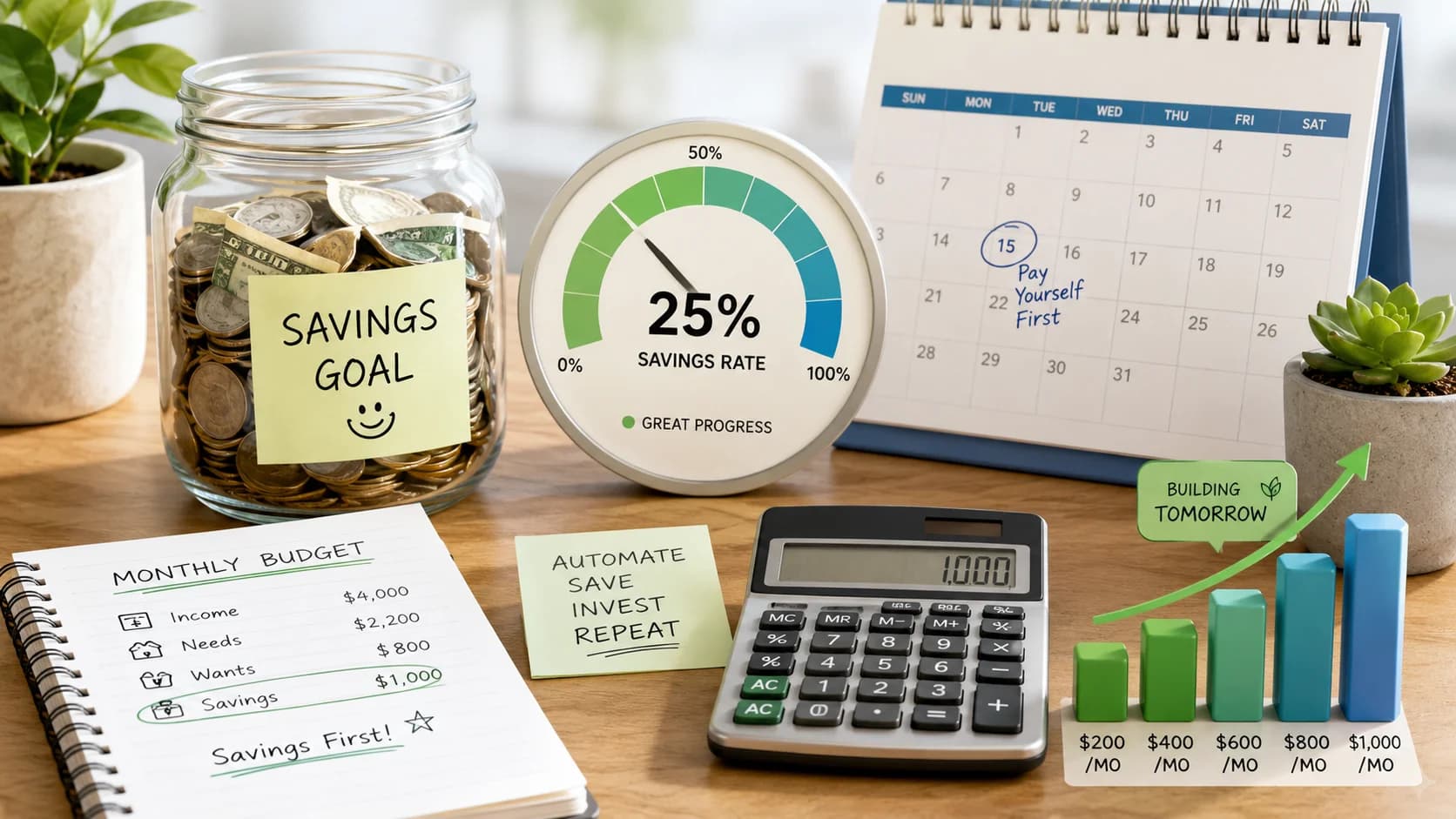
Savings Rate Calculator: How Much Should You Save Per Month?
Free Calculator
Savings Calculator
Table of Contents
The One Number That Predicts Financial Independence
Your savings rate — the percentage of your income you save — is the single most powerful variable in your financial life. It determines not just how fast your wealth grows, but how many years until you can stop working entirely.
A 10% savings rate means roughly 40+ years to financial independence. A 50% savings rate means roughly 17 years. The math is that dramatic.
Our savings rate calculator shows your current rate and what it means for your timeline. This guide explains how to calculate it and what to do with the number.
How to Calculate Your Savings Rate
Savings Rate = (Amount Saved ÷ Gross Income) × 100
The tricky part is defining "amount saved." Use the broadest definition:
- Contributions to 401(k), IRA, HSA
- Employer 401(k) match (it's compensation you're saving)
- Extra mortgage principal payments
- Any money moved to savings or investment accounts
Example: $75,000 Income
| Savings Source | Monthly Amount |
|---|---|
| 401(k) contribution | $500 |
| Employer match | $250 |
| Roth IRA | $200 |
| High-yield savings | $150 |
| Total saved | $1,100/month |
Monthly gross income: $75,000 ÷ 12 = $6,250
Savings rate: $1,100 ÷ $6,250 × 100 = 17.6%
What Your Savings Rate Means: Years to Financial Independence
This table assumes a 5% real return on investments and the "4% withdrawal rule" for retirement spending.
| Savings Rate | Years to Financial Independence |
|---|---|
| 5% | 66 years |
| 10% | 51 years |
| 15% | 43 years |
| 20% | 37 years |
| 25% | 32 years |
| 30% | 28 years |
| 40% | 22 years |
| 50% | 17 years |
| 65% | 10.5 years |
| 75% | 7 years |
Key insight: Going from a 10% to a 20% savings rate cuts your working years by 14. Going from 20% to 30% cuts another 9. The early jumps have the most leverage.
The Rule of 25: How Much Do You Need to Retire?
You need roughly 25× your annual spending saved to retire — this is derived from the 4% safe withdrawal rate.
Target = Annual spending × 25
| Annual Spending | Retirement Target |
|---|---|
| $30,000 | $750,000 |
| $40,000 | $1,000,000 |
| $50,000 | $1,250,000 |
| $60,000 | $1,500,000 |
| $80,000 | $2,000,000 |
Note: this is spending, not income. If you're saving 30% of your income, you're living on 70% — and you only need to replace that 70% in retirement.
The 50/30/20 Budget Rule and Where Savings Fit
The 50/30/20 rule is the most widely recommended budgeting framework for people who want a simple, sustainable system without tracking every dollar. The split works like this:
- 50% — Needs: housing, utilities, groceries, insurance, minimum debt payments, transportation to work
- 30% — Wants: dining out, streaming, hobbies, travel, clothing beyond basics
- 20% — Savings and debt repayment: retirement contributions, emergency fund, extra debt payments, investments
That 20% savings bucket is your target floor — not your ceiling. Here's how it plays out at three common income levels:
50/30/20 at $40,000 Annual Income ($3,333/month take-home)
| Category | Percentage | Monthly Amount |
|---|---|---|
| Needs | 50% | $1,667 |
| Wants | 30% | $1,000 |
| Savings / Debt | 20% | $667 |
50/30/20 at $60,000 Annual Income ($5,000/month take-home)
| Category | Percentage | Monthly Amount |
|---|---|---|
| Needs | 50% | $2,500 |
| Wants | 30% | $1,500 |
| Savings / Debt | 20% | $1,000 |
50/30/20 at $80,000 Annual Income ($6,667/month take-home)
| Category | Percentage | Monthly Amount |
|---|---|---|
| Needs | 50% | $3,333 |
| Wants | 30% | $2,000 |
| Savings / Debt | 20% | $1,333 |
The framework breaks down in high cost-of-living cities where rent alone consumes 40–50% of take-home pay. In those cases, compress the Wants category first — not savings. Your 20% savings target should be treated as close to non-negotiable as possible.
If you're carrying high-interest debt (credit cards above 15% APR), prioritize that within your 20% before building beyond a $1,000 emergency fund. Once high-interest debt is gone, redirect that payment entirely to savings and investments.
Savings Rate Benchmarks: What the Data Says
Knowing your personal savings rate is useful — but context matters. Here's where the benchmarks come from and what they mean for you.
The US Personal Savings Rate
The Bureau of Economic Analysis tracks the US personal savings rate monthly. Historically, Americans saved 8–12% of disposable income in the 1970s and 1980s. That rate has declined sharply — by 2005 it briefly turned negative. In 2025–2026, the rate hovers around 3–5%, which most financial planners consider dangerously low. The implication: the median American is saving far too little to retire comfortably at traditional ages.
FIRE Movement Targets
The Financial Independence, Retire Early (FIRE) movement has popularized aggressive savings rates. Depending on the variant:
- Lean FIRE: 60–70% savings rate, targeting extremely frugal retirement spending
- Regular FIRE: 40–50% savings rate, typical middle-class retirement lifestyle
- Fat FIRE: 25–35% savings rate, higher spending in retirement, longer timeline
- Barista FIRE / CoastFIRE: Save aggressively early, then reduce to part-time work once investments can "coast" to retirement
You don't need to pursue FIRE to benefit from its math. Even pushing from 10% to 20% compresses your working timeline by 14 years, as shown in the table above.
Fidelity Age-Based Savings Guidelines
Fidelity Investments publishes widely cited benchmarks for how much you should have saved relative to your salary at each age milestone. These assume you start saving at 25 and maintain roughly a 15% savings rate throughout your career.
| Age | Savings Target (multiple of annual salary) |
|---|---|
| 25 | 1× salary saved |
| 30 | 2× salary saved |
| 40 | 3× salary saved |
| 50 | 6× salary saved |
| 55 | 7× salary saved |
| 60 | 8× salary saved |
| 67 | 10× salary saved |
If you earn $70,000 and are 40 years old, Fidelity's benchmark says you should have roughly $210,000 saved. Behind? You're not alone — most Americans are. The answer is a higher savings rate, not panic. Use our retirement calculator to model exactly how much extra monthly savings closes your gap.
High-Yield Savings Accounts vs Money Market vs CDs in 2026
Once you've calculated your savings rate and committed to hitting your target, the next question is: where does the money go? Not all savings vehicles are equal in 2026. Here's a clear comparison of the three most common options for cash you want accessible within 1–3 years.
| Product | Typical APY (2026) | FDIC Insured? | Minimum Balance | Liquidity |
|---|---|---|---|---|
| High-Yield Savings Account (HYSA) | 4.50–5.00% | Yes (up to $250k) | $0–$1 | Instant (ACH 1–2 days) |
| Money Market Account (MMA) | 4.25–4.75% | Yes (up to $250k) | $1,000–$10,000 | Same-day / debit card access |
| Certificate of Deposit (CD) — 1-year | 4.75–5.25% | Yes (up to $250k) | $500–$1,000 | Locked until maturity (penalty to break) |
| Certificate of Deposit (CD) — 5-year | 4.00–4.50% | Yes (up to $250k) | $500–$1,000 | Locked 5 years (penalty to break) |
| Traditional Savings Account (big bank) | 0.01–0.50% | Yes (up to $250k) | $0 | Instant |
When to Use Each
- High-Yield Savings Account: Best for your emergency fund (3–6 months of expenses) and any cash you might need within 6–12 months. No penalty to withdraw. Online banks (Ally, Marcus, SoFi, Discover) typically offer the best HYSA rates. Avoid big-bank savings accounts — their rates are effectively zero relative to inflation.
- Money Market Account: Good for a larger emergency reserve or business operating cash. The higher minimum balance earns you slightly worse rates than top HYSAs but often includes check-writing and debit card access, making it more flexible for larger, infrequent withdrawals.
- CDs: Ideal for money you are certain you won't need for a specific period. In a rate-cutting environment (which 2026 is trending toward), locking in a 1-year CD at 5%+ can outperform a HYSA whose rate will drift down. Consider a CD ladder — spreading money across 3-month, 6-month, 1-year, and 2-year CDs — to balance yield and liquidity.
None of these replace investing for long-term goals. Money needed in 5+ years should be in a diversified investment account, not a savings vehicle. See our compound interest calculator to compare what $10,000 in a 5% HYSA vs a 7% investment account looks like over 20 years — the gap is enormous.
5 Ways to Increase Your Savings Rate Without Feeling Broke
The biggest barrier to saving isn't income — it's friction and habit. These five tactics work because they either remove friction from saving or reduce spending in ways that don't significantly impact quality of life.
1. Automate Transfers on Payday
Set up an automatic transfer from your checking account to your HYSA or investment account on the same day your paycheck hits. This is the single highest-impact action you can take. When money moves before you see it in your spending account, your brain treats it as already spent — on future-you. Start with whatever feels painless (even $50/month) and increase by $25–$50 every 90 days. Most people discover they don't miss money they never held.
2. Cancel Unused Subscriptions
The average American household pays for 4–5 subscription services they rarely use, according to multiple consumer surveys. Go through your bank statements for the past 3 months and flag every recurring charge. Cancel anything you haven't used in 30 days. This audit typically frees up $50–$150/month — $600–$1,800/year — with zero lifestyle impact. Use a tool like Rocket Money or just a 20-minute spreadsheet review. Repeat annually, because subscriptions accumulate.
3. Negotiate Bills Once a Year
Internet, cell phone, insurance, and streaming bills are all negotiable. Call your providers once a year and ask for a retention discount or a current promotional rate. The phrase "I'm considering switching to [competitor]" typically unlocks discounts of 10–20%. A 30-minute call can save $30–$80/month. On an annual basis, that's $360–$960 redirected to savings with no change to your lifestyle.
4. Meal Prep to Cut the Food Budget
Food is typically the third-largest household expense after housing and transportation — and one of the most compressible. The average American spends $166/month on restaurants (BLS Consumer Expenditure Survey). Replacing just half of restaurant meals with batch-cooked home meals typically saves $60–$100/month. Dedicate 2–3 hours on Sunday to prep lunches and dinners for the week. The savings are real; the friction is genuinely low once the habit is set.
5. Try the 1% Challenge
Rather than overhauling your entire budget at once, increase your savings rate by exactly 1 percentage point every 6 months. On a $60,000 income, 1% is $50/month. That's painless. But over 4 years, you've added 8 percentage points to your savings rate — the difference between a 12% rate and a 20% rate, which cuts your working timeline by roughly 8 years. Small, consistent increments compound just like interest does.
The Latte Factor: Small Cuts vs Big Wins
David Bach's "Latte Factor" — the idea that cutting your daily coffee habit could fund your retirement — became one of the most cited and most criticized personal finance concepts of the past two decades. The truth is more nuanced, and understanding it will make you a smarter saver.
Where the Latte Factor Goes Wrong
A $6 daily latte habit costs roughly $2,190/year. Invested at 7% over 30 years, that's about $220,000 — a genuinely impressive number. The problem is the underlying assumption: that the latte is the marginal dollar standing between you and wealth. For most households, it isn't.
Critics — including personal finance researchers like Ramit Sethi — point out that obsessing over $6 coffee while ignoring $1,500 in housing overpayment, $400 in unused car insurance coverage, or $600 in subscription bloat is optimizing the wrong variables. The math on small cuts is real but the emotional and behavioral cost of micromanaging every small pleasure can lead to budget fatigue and abandonment.
The Big Three: Where Your Money Actually Goes
Data from the Bureau of Labor Statistics consistently shows that three categories account for 65–70% of the average American household's spending:
- Housing (33%): Rent or mortgage, utilities, maintenance, property taxes. This is where the biggest wins live. Downsizing, getting a roommate, or buying in a lower cost-of-living area can free $500–$1,500/month — more than any other single change.
- Transportation (16%): Car payments, insurance, fuel, maintenance. The average car payment in 2026 is $735/month for a new vehicle. Driving a paid-off used car vs financing a new one is worth $500–$700/month — roughly 100 lattes.
- Food (13%): Groceries and dining out. This is where meal prep and restaurant spending habits matter — but the ceiling on savings here is $100–$300/month for most households, not life-changing amounts on their own.
The Right Mental Model
The Latte Factor is useful as an entry point — it teaches people to notice that small daily habits have compound consequences. But the highest-leverage financial decisions are the Big Three: where you live, what you drive, and whether you have dependents and how you structure your life around them. Get those right first, then optimize the margins. Use our mortgage calculator to see exactly how housing decisions affect your monthly savings capacity.
How to Increase Your Savings Rate Without Earning More
The Spending Audit Method
Track every expense for one month and categorize:
- Fixed necessary: rent, utilities, insurance, minimum debt payments
- Variable necessary: groceries, gas, healthcare
- Discretionary: dining out, subscriptions, entertainment, shopping
Target: reduce discretionary by 20–30% and redirect to savings. Most people find $200–$500/month in discretionary spending they don't strongly value.
The Pay Yourself First Method
Automate savings transfers on payday, before you can spend. Set up automatic 401(k) contributions and automatic transfers to a high-yield savings account. What you don't see, you don't spend.
Research consistently shows automated savers save more than manual savers — not because of discipline, but because the friction is removed.
The Raise Redirect Method
Every time you get a raise, split it: half to lifestyle, half to savings. A 5% raise on $75,000 = $3,750/year extra. Redirect $1,875 to savings and your rate jumps roughly 2.5 percentage points while your take-home still improves.
Related Finance Calculators
- Compound Interest Calculator — see what your savings become over time
- Retirement Calculator — full retirement projection with Social Security
- Salary to Hourly Calculator — convert your income for savings math
- Mortgage Calculator — housing cost vs savings trade-off
Frequently Asked Questions
How much should I save per month?
The standard recommendation is 15% of gross income for retirement. A more aggressive target is 20–25% if you want options before traditional retirement age. Start with whatever you can automate today and increase by 1% every 6 months. Even $100/month at age 25 becomes roughly $35,000 by age 65 at a 7% return — and significantly more if you invest rather than just save.
Should I include my employer match in my savings rate?
Yes — employer match is part of your total compensation and it's going directly to your retirement. Including it gives you an accurate picture of your total savings rate and prevents discouraging under-counting. If your employer matches 3% and you contribute 10%, your effective savings rate is 13% — worth knowing.
Is a 10% savings rate enough?
For someone starting at 22 with a 40-year runway, yes — compound growth does the heavy lifting. For someone starting at 35, 10% likely means working into your late 60s. The later you start, the higher the rate needs to be. Our savings rate calculator can show you your specific timeline based on your current age and rate.
What is the average American savings rate?
The US personal savings rate fluctuates significantly — it spiked to 30%+ during COVID stimulus and has since settled to roughly 3–5% in 2025–2026. Most financial advisors consider this dangerously low. The 15% target is a minimum, not a ceiling.
Should I save or pay off debt first?
It depends on the interest rate. High-interest debt (credit cards at 20%+ APR) should almost always be prioritized over investing, since guaranteed 20% debt elimination beats expected 7–10% investment returns. The exception: always capture your full employer 401(k) match first — that's an instant 50–100% return on that money. Once high-interest debt is cleared, split extra cash between emergency fund and investing based on your risk tolerance and timeline.
What counts as savings vs investment?
For the purposes of calculating your savings rate, both count equally — money moving out of your spending pool toward future-you. The distinction matters for risk: savings (HYSA, CDs, money market) preserve principal with lower returns; investments (stocks, bonds, index funds) grow principal over time with more volatility. A healthy financial plan includes both: a liquid emergency fund in savings vehicles and long-term growth in investments. The compound interest calculator shows clearly why the investment portion matters more for goals 10+ years out.
For decade-by-decade savings targets, read our retirement savings by age guide covering Fidelity and Vanguard benchmarks.
Related Calculators
Try these free calculators related to this article:
In-Depth Guides
Dive deeper with our comprehensive guides on this topic:
Frequently Asked Questions
Our Methodology
All savings content on CalculatorApp.me is reviewed by subject-matter experts, cross-referenced with official sources, and updated regularly for accuracy. Our formulas and data are verified against industry standards and government publications.
Jordan Hayes
Verified AuthorPersonal Finance Content Strategist
Jordan is a personal finance content strategist with 9+ years writing about mortgages, retirement, tax strategy, and budgeting. Every guide is cross-referenced with IRS publications, Federal Reserve data, and CFPB guidance to make complex calculations accessible. Editor at CalculatorApp.me.
Found this helpful? Share it!
Stay Updated
Get notified when we launch new calculators and features.
No spam. Unsubscribe anytime.