Calorie Deficit Calculator: The Safe Minimum by Body Weight (2026)
Free Calculator
BMI Calculator
Table of Contents
What Is a Calorie Deficit and Why Size Matters
A calorie deficit occurs when you eat fewer calories than your body burns (your TDEE). Your body then turns to stored energy — primarily body fat — to make up the shortfall. This is the mechanism behind every form of fat loss, regardless of the diet name attached to it.
The standard figure you will see everywhere is: 3,500 calories = 1 pound (0.45 kg) of fat. Create a 500-calorie daily deficit and you lose roughly 1 lb per week. But this rule has important limitations that change how you should approach your deficit.
The 3,500-Calorie Rule: What It Gets Wrong
The 3,500-calorie rule was derived from early 20th century research and treats the body as a static machine. The reality is dynamic:
- Adaptive thermogenesis: Your body reduces TDEE in response to a sustained calorie deficit — NEAT drops, BMR decreases by 5–15%, and you become more efficient at using energy. This is why fat loss slows after 4–6 weeks even if eating stays constant.
- Composition of weight lost: At large deficits (over 700 cal/day), a significant portion of weight lost is lean mass (muscle), not fat. Smaller deficits preserve muscle better.
- Starting body fat matters: Leaner individuals lose muscle mass more readily on a large deficit than individuals with more fat to draw from.
The take: a moderate deficit of 300–500 calories/day is the evidence-backed sweet spot for most people — fast enough to make progress, slow enough to preserve muscle and avoid metabolic adaptation.
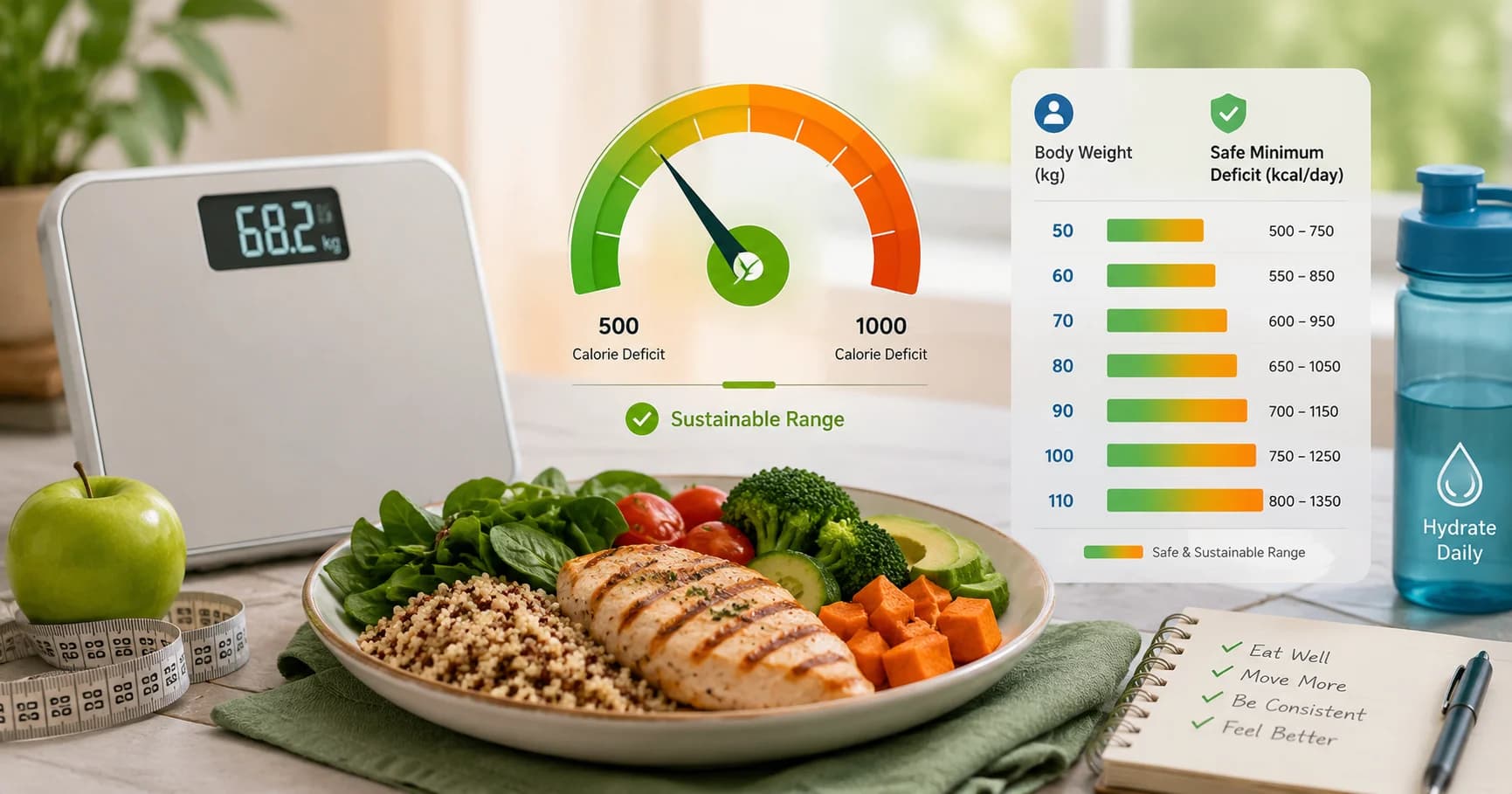
Safe Minimum Calorie Deficit by Body Weight
The safe deficit range scales with your body weight and starting body fat. These figures are drawn from sports nutrition research and clinical obesity guidelines:
| Body Weight | Minimum Daily Calories (Women) | Minimum Daily Calories (Men) | Max Safe Deficit |
|---|---|---|---|
| 50–60 kg (110–132 lb) | 1,200 cal | 1,400 cal | 300–400 cal/day |
| 60–75 kg (132–165 lb) | 1,300 cal | 1,500 cal | 400–500 cal/day |
| 75–90 kg (165–198 lb) | 1,400 cal | 1,600 cal | 500–600 cal/day |
| 90–110 kg (198–242 lb) | 1,500 cal | 1,700 cal | 600–750 cal/day |
| Over 110 kg (over 242 lb) | 1,600 cal | 1,800 cal | 750–1,000 cal/day |
Never go below 1,200 calories/day (women) or 1,400 calories/day (men) without medical supervision. Below these floors, it becomes extremely difficult to get adequate protein, micronutrients, and fibre — and muscle loss accelerates significantly.
How to Calculate Your Personal Calorie Deficit
Step 1: Calculate your TDEE with the TDEE Calculator guide or use our TDEE Calculator directly.
Step 2: Choose your weekly loss target:
- 0.25 kg/week (0.5 lb): deficit of ~275 cal/day — best for lean individuals or those close to goal weight
- 0.5 kg/week (1 lb): deficit of ~550 cal/day — standard recommendation for most people
- 0.75 kg/week (1.5 lb): deficit of ~825 cal/day — appropriate only if significantly overweight (BMI 30+)
- 1 kg/week (2 lb): deficit of ~1,100 cal/day — only with medical supervision; high risk of muscle loss
Step 3: Subtract the deficit from your TDEE to get your daily calorie target.
Example: TDEE = 2,100 cal/day. Goal = 0.5 kg/week. Daily target = 2,100 − 550 = 1,550 calories/day.
Protein: The Non-Negotiable Variable in a Deficit
When in a calorie deficit, protein intake determines how much of the weight lost is fat vs. muscle. The research is clear: eating 1.6–2.2 g of protein per kg of bodyweight while in a deficit preserves significantly more lean mass than lower intakes.
For a 75 kg person: 1.6 × 75 = 120 g protein/day minimum while cutting. At 2.2 g/kg: 165 g/day.
Use our Protein Calculator to find your target, and our Macro Calculator to distribute remaining calories between carbs and fat.
How Long Should You Stay in a Deficit?
Research on diet breaks and refeeds shows that continuous long deficits (over 12 weeks) cause greater adaptive thermogenesis than structured approaches. A practical framework:
- 8–12 weeks cutting → 2–4 weeks maintenance (diet break) → repeat
- Or: 5 days deficit + 2 days maintenance each week (modified deficit approach)
The goal of the maintenance phase is not to undo progress — it is to reset NEAT, leptin levels, and metabolic rate before the next deficit phase. This approach produces more fat loss over 6 months than a continuous identical deficit.
Signs Your Deficit Is Too Large
- Losing more than 1% of bodyweight per week consistently
- Strength dropping significantly in the gym (losing more than just water weight from muscles)
- Extreme fatigue, brain fog, or difficulty concentrating
- Hair shedding (a sign of micronutrient deficiency or too-low calorie intake)
- Sleep disruption or cold intolerance
If you experience these, increase daily intake by 150–200 calories for 1–2 weeks before resuming the deficit.
The Full Health Calculator Chain
- BMI Calculator — Start with your body mass index
- TDEE Calculator — Find your total daily energy expenditure
- Calorie Deficit Calculator — Set your daily calorie target
- Macro Calculator — Split calories into protein, carbs, fat
- Protein Calculator — Confirm protein target for muscle preservation
For the full science behind choosing your deficit size and protecting muscle, read our complete calorie deficit guide.
Related Calculators
Try these free calculators related to this article:
In-Depth Guides
Dive deeper with our comprehensive guides on this topic:
Frequently Asked Questions
Our Methodology
All health content on CalculatorApp.me is reviewed by subject-matter experts, cross-referenced with official sources, and updated regularly for accuracy. Our formulas and data are verified against industry standards and government publications.
Jordan Hayes
Verified AuthorPersonal Finance Content Strategist
Jordan is a personal finance content strategist with 9+ years writing about mortgages, retirement, tax strategy, and budgeting. Every guide is cross-referenced with IRS publications, Federal Reserve data, and CFPB guidance to make complex calculations accessible. Editor at CalculatorApp.me.
Found this helpful? Share it!
Stay Updated
Get notified when we launch new calculators and features.
No spam. Unsubscribe anytime.