Ideal Weight by Height: What the Charts Really Mean for Your Body
Free Calculator
BMI Calculator
Table of Contents
Bottom line: "Ideal weight" is a range, not a single number — and it depends heavily on your height, sex, age, and muscle mass. The most commonly cited formulas (Devine, Robinson, Miller, Hamwi) all give similar estimates but can diverge by 10–20 lbs. A 5'6" woman has an "ideal weight" of 130–143 lbs by Devine's formula — but a well-muscled 5'6" woman athlete may be healthy at 155 lbs. Use our ideal weight calculator to see estimates from all major formulas side by side, then cross-check with body composition for a complete picture.
Key Takeaways
- Four major formulas (Devine, Robinson, Miller, Hamwi) all produce similar ideal weight estimates within a 10–15 lb range for most heights.
- Ideal weight charts were developed for drug dosing in clinical settings — they were never designed as aesthetic or fitness targets.
- A healthy BMI range (18.5–24.9) translates to a wide weight range — about 40–50 lbs wide for most heights.
- Body fat percentage and waist-to-height ratio predict health outcomes better than scale weight alone.
- Muscle weighs more than fat by volume — a muscular person at "overweight" BMI can be metabolically healthier than a thin person at "normal" BMI.
- Use the ideal weight calculator alongside the body fat calculator for a complete body composition picture.
Ideal Weight by Height: Reference Charts
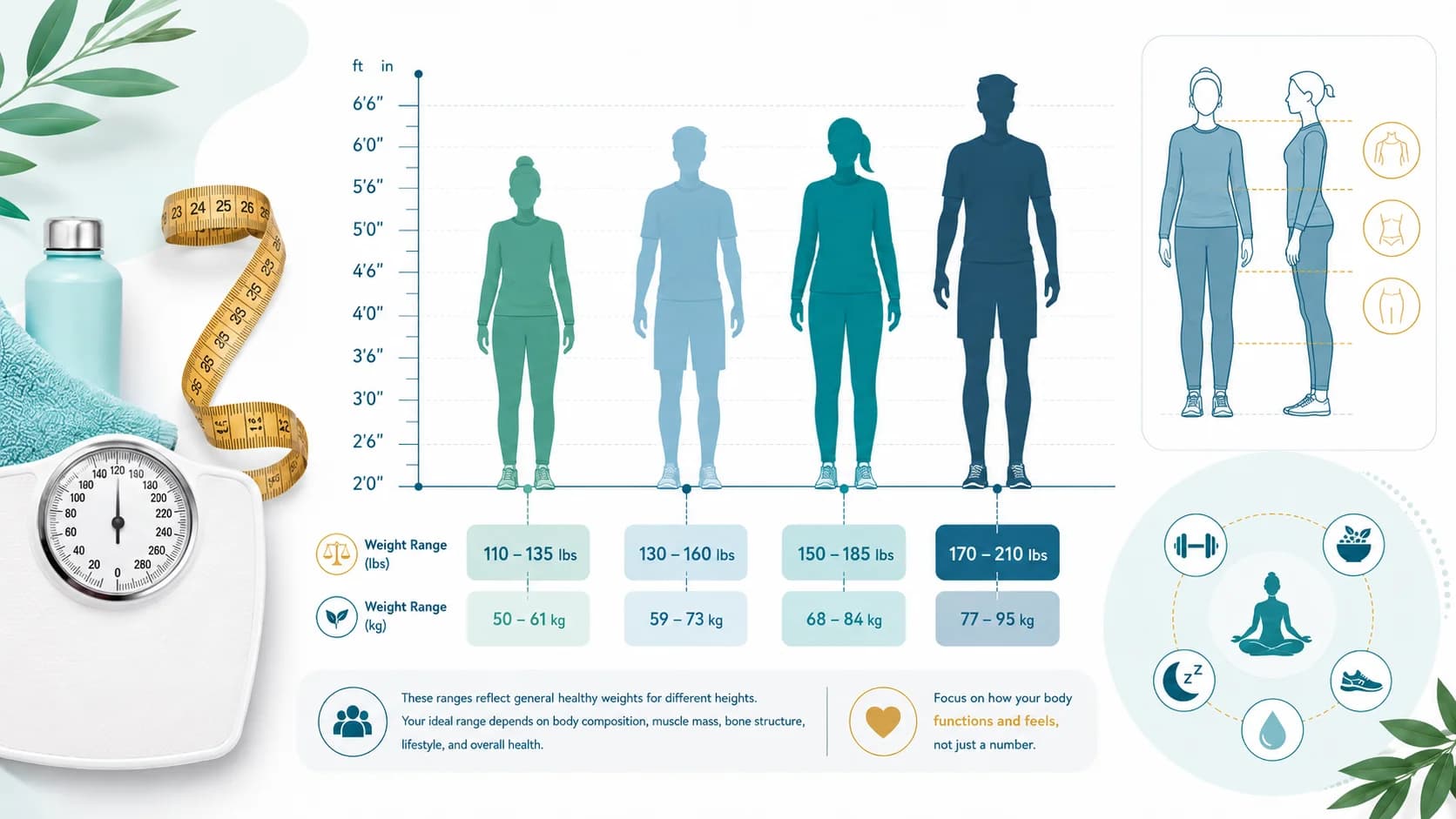
The table below shows ideal weight ranges for common heights using both BMI (18.5–24.9) as the healthy range and the Devine formula (the most widely used clinical formula). Use these as starting reference points, not hard targets.
| Height | BMI Range (18.5–24.9) | Devine Formula — Women | Devine Formula — Men |
|---|---|---|---|
| 5'0" (152 cm) | 95–127 lbs | 100 lbs | 110 lbs |
| 5'2" (157 cm) | 101–136 lbs | 105 lbs | 118 lbs |
| 5'4" (163 cm) | 108–145 lbs | 110 lbs | 126 lbs |
| 5'6" (168 cm) | 115–154 lbs | 120 lbs | 133 lbs |
| 5'8" (173 cm) | 122–164 lbs | 130 lbs | 141 lbs |
| 5'10" (178 cm) | 129–174 lbs | 140 lbs | 149 lbs |
| 6'0" (183 cm) | 136–184 lbs | 150 lbs | 157 lbs |
| 6'2" (188 cm) | 144–194 lbs | 160 lbs | 165 lbs |
The BMI healthy range column gives a 30–40 lb span for each height — reflecting the biological diversity of healthy body compositions. The Devine formula gives a single midpoint estimate that falls near the middle of the BMI healthy range. Neither is wrong; they serve different purposes.
The Four Major Ideal Weight Formulas
All four standard formulas were developed between the 1960s and 1980s for estimating drug dosing in clinical settings. They are based on height and sex only — no age, muscle mass, or frame size adjustment.
| Formula | Men (5'10" example) | Women (5'6" example) | Developed For |
|---|---|---|---|
| Devine (1974) | 166 lbs | 130 lbs | Drug dosing |
| Robinson (1983) | 160 lbs | 127 lbs | Drug dosing revision |
| Miller (1983) | 164 lbs | 133 lbs | Drug dosing revision |
| Hamwi (1964) | 166 lbs | 135 lbs | Clinical estimation |
The formulas agree within about 6 lbs for men and 8 lbs for women at most heights. Our ideal weight calculator shows the output of all four formulas plus the BMI healthy range so you can see the full picture at once.
Why "Ideal Weight" Is a Range, Not a Number
The concept of a single ideal weight is biologically invalid. Healthy people of the same height and sex differ in:
- Bone density and frame size: A large-framed person has heavier bones and joints. Frame size alone accounts for a 10–15% variation in healthy weight at the same height.
- Muscle mass: A trained athlete carries significantly more muscle than a sedentary person. Muscle is denser than fat — two people at the same weight look very different if one has 15% body fat and the other has 30%.
- Age: Muscle mass naturally decreases with age. Older adults typically weigh less but may have higher body fat percentages. Healthy weight ranges for older adults are somewhat higher than young-adult formulas suggest.
- Ethnicity: Body fat distribution and metabolic risk vary by ethnicity. Asian populations show higher metabolic risk at lower BMIs, prompting WHO to suggest lower BMI thresholds for Asian adults.
Better Health Metrics Than Scale Weight
Scale weight is a starting point, not a complete health measure. These metrics add critical context:
Body Fat Percentage
Body fat percentage directly measures what you actually want to know — how much of your body is fat vs. lean mass. A person at "ideal weight" by the Devine formula but with 32% body fat is less metabolically healthy than one 15 lbs heavier with 18% body fat. Check your estimated body fat with our body fat calculator and see our full guide on healthy body fat percentage ranges.
Waist-to-Height Ratio
A waist circumference less than half your height is associated with significantly lower risk of metabolic syndrome, cardiovascular disease, and type 2 diabetes — across all ethnicities. This "keep your waist less than half your height" rule is simpler and more universally valid than BMI-based ideal weight. For a 5'6" (66") person, a waist under 33" is the target.
BMI as a Screening Tool
BMI (weight ÷ height²) identifies probable overweight and obesity at scale. The healthy range of 18.5–24.9 corresponds well to low metabolic risk for the general population — though it fails for muscular athletes and underestimates risk for people with high visceral fat at normal BMI. Check your BMI with our BMI calculator and see why it has limitations in our post on why BMI is flawed.
How to Find Your Healthy Weight Range
Rather than targeting a single number, use this multi-metric approach:
- Calculate your BMI healthy weight range — the weight range corresponding to BMI 18.5–24.9 for your height. This is your broad target zone. Use our BMI calculator.
- Check your current body fat percentage — use our body fat calculator. If you are at ideal weight by BMI but body fat is above 25% (men) or 32% (women), focus on building muscle rather than just losing weight.
- Measure your waist-to-height ratio — waist in inches ÷ height in inches should be under 0.5. If your weight is in the healthy BMI range but this ratio is above 0.5, reducing visceral fat through aerobic exercise is the priority.
- Assess your ideal weight formula estimate via our ideal weight calculator — this gives you the clinically derived single-number estimate as a reference point.
Frequently Asked Questions About Ideal Weight
What is the ideal weight for a 5'4" woman?
By the Devine formula, ideal weight for a 5'4" woman is approximately 110 lbs. By the BMI healthy range (18.5–24.9), the range is 108–145 lbs. Most fitness and health professionals consider 115–135 lbs a realistic healthy weight range for a 5'4" woman, acknowledging that body composition (muscle vs. fat) matters more than any specific number.
Is it possible to be healthy at a weight above your "ideal"?
Yes. A muscular athlete who weighs 20 lbs above their Devine ideal weight formula estimate can have excellent metabolic health — good blood pressure, blood glucose, cholesterol, and body fat percentage. The ideal weight formulas were never validated as predictors of individual health outcomes; they were designed for drug dosing calculations.
Does ideal weight change as you age?
Healthy weight ranges shift slightly with age. After 65, being slightly above the traditional ideal weight is not necessarily harmful and may be protective — studies show that mildly overweight older adults have lower mortality rates than underweight ones. The "obesity paradox" suggests that older bodies may benefit from modest fat reserves. Focus shifts from weight toward maintaining muscle mass and functional strength.
How much does frame size affect ideal weight?
Frame size (bone structure) accounts for roughly 10–15% variation in healthy weight at a given height. A large-framed 5'6" woman can be healthy at 140–150 lbs while a small-framed 5'6" woman might be healthiest at 120–130 lbs. Wrist circumference is a quick proxy for frame size: <5.5" = small, 5.5–6.5" = medium, >6.5" = large (for women).
Related Calculators
Try these free calculators related to this article:
In-Depth Guides
Dive deeper with our comprehensive guides on this topic:
Frequently Asked Questions
Our Methodology
All ideal weight content on CalculatorApp.me is reviewed by subject-matter experts, cross-referenced with official sources, and updated regularly for accuracy. Our formulas and data are verified against industry standards and government publications.
Jordan Hayes
Verified AuthorPersonal Finance Content Strategist
Jordan is a personal finance content strategist with 9+ years writing about mortgages, retirement, tax strategy, and budgeting. Every guide is cross-referenced with IRS publications, Federal Reserve data, and CFPB guidance to make complex calculations accessible. Editor at CalculatorApp.me.
Found this helpful? Share it!
Stay Updated
Get notified when we launch new calculators and features.
No spam. Unsubscribe anytime.