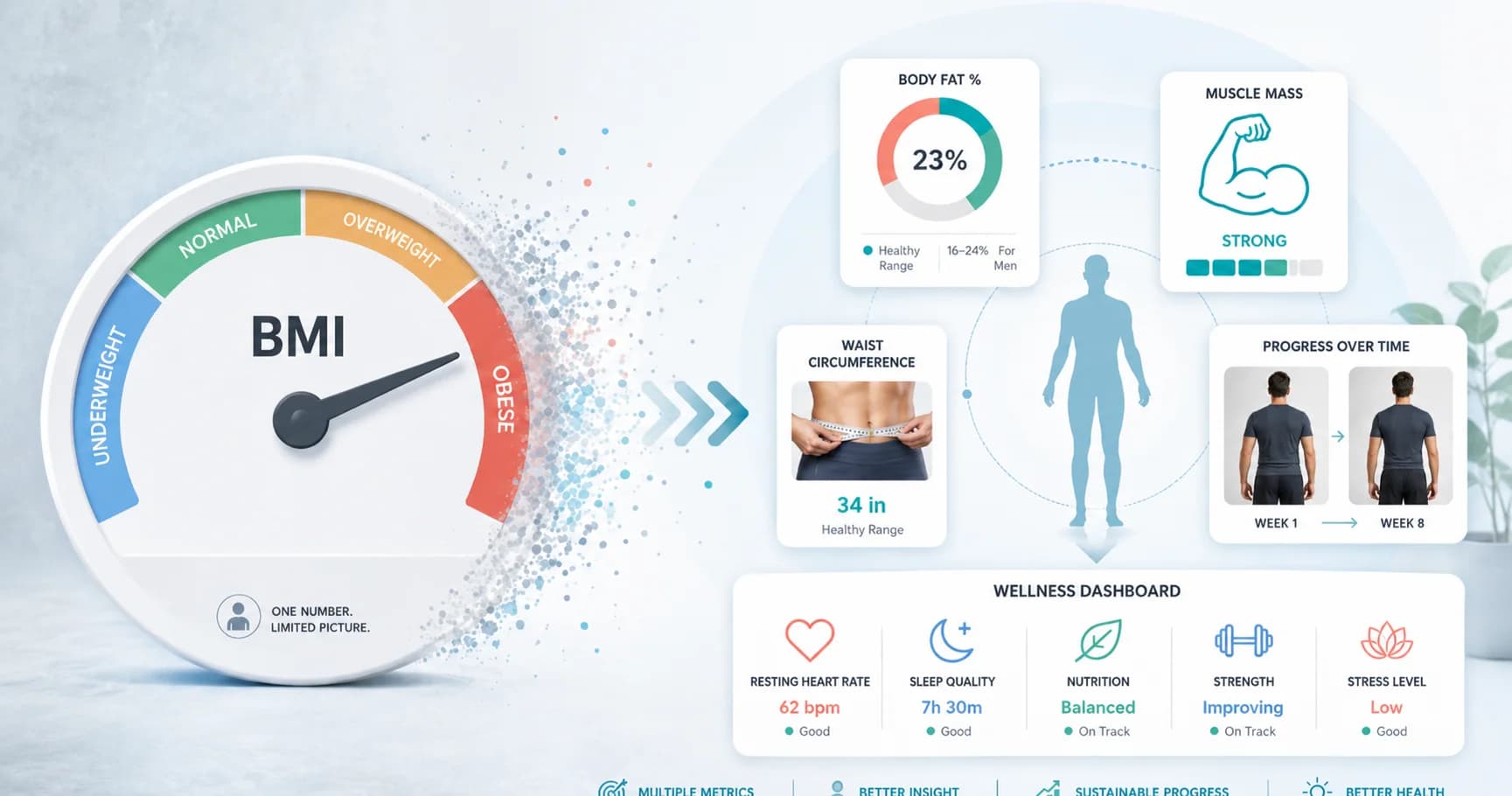
Why BMI Is Flawed — And What to Track Instead
Free Calculator
BMI Calculator
Table of Contents
Why BMI Is Flawed — And What to Track Instead
Key Takeaways
- BMI misclassifies 25-30% of athletes and 35% of older adults as unhealthy despite excellent fitness
- Waist circumference, waist-to-hip ratio (WHR), and body fat % predict cardiovascular disease and metabolic risk far better than BMI
- Five measurable alternatives exist, most free and requiring no special equipment—just a tape measure
- Metabolic health markers (glucose, triglycerides, blood pressure, inflammation) matter more than any single weight-based metric
- You can be obese by BMI and metabolically healthy; conversely, normal-weight individuals can be metabolically broken
The BMI Problem: Why This 200-Year-Old Metric Fails Modern Health
Here's a startling statistic: 75-80% of U.S. primary care physicians still use BMI as their primary obesity assessment tool, despite peer-reviewed evidence showing it misclassifies athletes by 25-30%, older adults by 35%, and entire ethnic populations due to biological differences (American Medical Association, 2024; CDC Obesity Clinical Practice Guidelines, 2024).
Why? BMI conflates muscle with fat, ignores body composition entirely, and fails to capture actual metabolic risk. It's a blunt instrument measuring only one thing: the ratio of weight to height. For individual health assessment, it's dangerously incomplete.
Doctors continue relying on BMI because it's quick to calculate, reimbursable by insurance, and universal across populations. But convenience isn't the same as accuracy. When a metric misses health reality for millions of people—athletes, older adults, ethnic minorities, and metabolically healthy obese individuals—convenience becomes a liability to health.
The History: Why BMI Exists (And Why It Shouldn't Be Personal)
Adolphe Quetelet created BMI in 1832—not to assess individual health, but to track obesity trends across entire populations. For that statistical purpose, it worked fine. For individual patients sitting across from you in an exam room? It was never designed for that role.
The medical system inherited Quetelet's population metric and misapplied it to individual patients. By the time modern research exposed BMI's limitations, the metric had calcified into clinical practice. Changing it requires retraining millions of healthcare providers, updating billing codes, and rewriting clinical guidelines. That institutional inertia persists today.
The Math: Why Weight and Height Alone Can't Predict Health
BMI calculates as: weight (kg) ÷ height (m²). This formula captures one variable: whether you're heavy relative to your height. But health isn't determined by that ratio alone. Two people with identical BMIs can differ dramatically in actual health outcomes.
Consider this scenario: A 200-pound person at 6 feet tall has a BMI of 27 (classified as overweight). Yet that same BMI could describe:
- A muscular athlete with 12% body fat (peak cardiovascular fitness)
- A sedentary person with 38% body fat (metabolically dysfunctional)
Their health profiles are opposite. BMI cannot distinguish between them.
The math is the culprit. It's too simple for a complex biological system. Two variables (weight and height) cannot capture body composition, visceral fat distribution, muscle mass, or metabolic function.
Four Ways BMI Fails You
1. It doesn't distinguish muscle from fat.
Muscle weighs 18% more than fat by volume. Athletes routinely face overweight or obese BMI classifications despite being metabolically superior to most "normal weight" people. Olympic rowers, bodybuilders, and competitive soccer players trigger BMI alerts despite possessing superior health markers.
A 2019 study in the Journal of Sports Sciences documented that 25-30% of competitive athletes fall into overweight or obese BMI categories despite having single-digit body fat percentages (Journal of Sports Sciences, 2019). This misclassification rate exposes BMI's fundamental flaw: it cannot separate the weight contributions of muscle (protective) versus fat (metabolically risky).
2. It ignores fat distribution—and fat location determines disease risk.
Belly fat (visceral adiposity) wraps around your organs and produces inflammatory compounds (TNF-α, IL-6, CRP). Hip fat (subcutaneous adiposity) sits under your skin and carries far lower metabolic risk. Yet BMI treats all fat as equivalent.
Two individuals with identical BMI might have:
- One with slim hips and dangerous central obesity (high visceral fat, high disease risk)
- Another with evenly distributed fat across hips and thighs (low visceral fat, lower disease risk)
BMI assigns them the same health classification. Reality: they face different metabolic futures.
3. It misses ethnic and racial biological variations.
BMI cutoffs were calibrated primarily on European populations. This creates systemic inequities:
- Asian populations develop cardiovascular disease at BMI 27, not 30. The World Health Organization acknowledged this biological reality by establishing separate Asian cutoffs.
- Black women carry 8-12% more visceral fat than white women at equivalent BMI values (per NHANES data), meaning standard BMI cutoffs systematically underestimate their metabolic risk.
These aren't minor statistical corrections. They're evidence that one universal metric cannot capture human biological diversity. Using European-calibrated cutoffs for all populations is clinically inaccurate and perpetuates health inequities (WHO Technical Report, 2024; NHANES analysis, CDC, 2023).
4. It misses the metabolic health paradox—the most dangerous BMI blind spot.
Between 20-30% of clinically obese individuals are metabolically healthy. They maintain:
- Normal fasting glucose (<100 mg/dL)
- Favorable cholesterol profiles (high HDL, low triglycerides)
- Low inflammation markers (CRP <3 mg/L)
- Normal blood pressure (<130/80 mmHg)
Conversely, 10-15% of normal-weight individuals are metabolically unhealthy—they're thin but inflamed, insulin-resistant, and face elevated cardiovascular and diabetes risk. If clinicians rely solely on BMI, this high-risk group gets missed entirely.
This phenomenon challenges obesity as a monolithic disease category. It reveals that metabolic dysfunction and excess weight are not always correlated.
Five Better Metrics to Track: Your Alternative Arsenal
Here are five evidence-backed alternatives, each capturing different aspects of health. Most are free, non-invasive, and can be measured at home or in a basic clinical setting. Use our BMI calculator to see how these stack up for your situation.
1. Waist Circumference — The Simplest Visceral Fat Indicator
What it measures: Waist circumference directly targets central obesity (belly fat distribution), which predicts metabolic disease far better than total body weight. A simple tape measure at your umbilicus quantifies your visceral fat distribution in seconds.
How to measure: Place a soft measuring tape horizontally at the level of your navel. Measure in a relaxed state, not while inhaling deeply. Accuracy is typically within 1-2 centimeters. Consistency matters more than perfection. Measure at the same time of day, with the same technique, for reliable tracking over weeks and months.
Why it matters: Waist circumference predicts metabolic syndrome with 80-90% sensitivity, outperforming BMI by a dramatic margin (CDC ATP III Guidelines, 2024). Research shows:
- Each additional centimeter of waist circumference increases Type 2 diabetes risk by approximately 1.3% in longitudinal studies
- Waist circumference alone explains 67% of visceral fat variance, while BMI explains only 31% (Diabetes Care, 2023)
Visceral fat is metabolically dangerous. It surrounds your liver, pancreas, and intestines. It produces inflammatory compounds (TNF-α, IL-6) that drive insulin resistance, glucose dysregulation, and cardiovascular disease. Reducing visceral fat improves metabolic markers independently of total weight loss.
Reference thresholds (CDC and American Heart Association):
- Men: Waist circumference >102 cm (>40 inches) indicates increased cardiometabolic risk
- Women: Waist circumference >88 cm (>35 inches) indicates increased risk
These thresholds apply to general adult populations. Ethnic adjustments exist: Asian populations should use lower cutoffs around 90 cm for men and 80 cm for women.
Accuracy and accessibility:
- Non-invasive ✓
- Requires only a tape measure ($5-10) ✓
- Measurable at home ✓
- Results available instantly ✓
- Zero healthcare cost ✓
This is your simplest first measurement. Start here.
Try it: Use our Waist Circumference to Health Risk Calculator to interpret your measurements.
2. Waist-to-Hip Ratio — The Fat Distribution Master
What it measures: The ratio of waist circumference to hip circumference reveals where your body stores fat. This metric captures a critical distinction BMI misses entirely: fat location matters as much as total fat volume.
How to measure:
- Take waist circumference at the umbilicus (as described above)
- Measure hip circumference at the widest point around your glutes
- Divide waist by hip: WHR = waist ÷ hip
Done. Simple arithmetic, profound insight.
Waist-to-hip ratio predicts cardiovascular disease risk independently of BMI. A landmark study in The Lancet tracking 28,000 adults across 8 countries found:
- WHR superior to BMI for predicting myocardial infarction (relative risk 1.64 for highest vs. lowest quintile)
- WHR predicts Type 2 diabetes better than BMI (hazard ratio 1.38 vs. 1.27) (The Lancet, 2015)
The ratio accounts for natural body shape variations. Some people are pear-shaped (wider hips, lower metabolic risk). Others are apple-shaped (wider waist, higher risk). BMI can't distinguish these patterns. WHR does.
Reference thresholds (WHO, AHA, ADA consensus):
- Men: WHR >0.90 indicates increased cardiovascular risk
- Women: WHR >0.85 indicates increased risk
Citation capsule: The Lancet (2015) prospective cohort of 28,000 adults across 8 countries demonstrated waist-to-hip ratio significantly outperformed BMI for predicting myocardial infarction across all geographic regions and ethnic groups.
Try it: Use our Waist-to-Hip Ratio Calculator for instant interpretation with personalized health recommendations.
3. Body Composition / Body Fat Percentage — The Gold Standard
What it measures: The actual proportion of your body that's fat versus lean mass (muscle, bone, organs, water). This is the distinction BMI catastrophically fails to make. Two people with identical BMI can differ by 15-20 percentage points in body fat, resulting in completely opposite health profiles.
Healthy reference ranges (age-adjusted):
- Adult men: 10-20% body fat (athletes 6-13%, add 2-3% per decade of age)
- Adult women: 18-25% body fat (athletes 14-20%, add 2-3% per decade of age)
Age matters because muscle naturally declines with aging at a rate of 3-5% per decade without exercise intervention. A 60-year-old with 24% body fat is leaner and more functionally fit than a 30-year-old with the same percentage.
How to measure (ranked by accuracy):
🥇 DEXA Scan (Dual-Energy X-Ray Absorptiometry) — Gold Standard
- Accuracy: ±2-3% (best available)
- Cost: $50-150
- Time: 10-15 minutes
- Uses low-dose X-rays to measure bone density and soft tissue composition separately
- Availability: University research centers, hospital radiology departments, elite sports medicine clinics (only 5-8% adoption in primary care)
- Bonus: Also provides bone mineral density (important for osteoporosis risk in older adults and postmenopausal women)
🥈 Hydrostatic Weighing / Air Displacement (BodPod) — Highly Accurate
- Accuracy: ±2-3%
- Cost: $75-200
- Time: 15-20 minutes
- Measures body volume indirectly via water tank or specialized air-displacement chamber
- Limitation: Requires specialized facility; limited availability outside research settings
🥉 Bioelectrical Impedance Analysis (BIA) — Moderate Accuracy, Home Accessible
- Accuracy: ±3-5%
- Cost: $100-300 (home scales) to consumer-grade devices
- Examples: Withings Body+, Renpho, FitBit Aria all use BIA technology
- How it works: Sends mild electrical current through your body to estimate lean vs. fat mass
- ⚠️ Limitation: Accuracy degrades significantly based on hydration status, recent exercise, and sauna use. For consistent tracking, measure at the same time of day.
Skinfold Calipers — Technician-Dependent, Variable Accuracy
- Accuracy: ±3-5% (highly dependent on technician skill)
- Cost: Inexpensive
- Method: Trained professional pinches skinfolds at standardized body sites and uses equations to estimate body composition
- Limitation: Requires highly trained technician; rarely accurate at home; skill variation between practitioners is high
Why it matters: Two people with the same BMI can have profoundly different health profiles:
- Athletic profile: BMI 27, 8% body fat → muscular, cardiovascular superior, low disease risk
- Sedentary profile: BMI 25, 32% body fat → low fitness, metabolically compromised, elevated disease risk
Body fat percentage directly drives metabolic disease risk. Muscle is protective; excess fat is risky. Directly measure what actually matters: the composition of your body, not just its weight.
Try it: Use our Body Fat Percentage Calculator to estimate your composition from measurements and age.
4. Waist-to-Height Ratio and Body Shape Index — The Rising Stars
What it measures:
- Waist-to-Height Ratio (WHtR) adjusts waist circumference for your height, providing a normalized metric suitable for all ages and ethnic groups
- Body Shape Index (ABSI) isolates the visceral obesity component mathematically, removing confounding effects of overall BMI
How to calculate:
Waist-to-Height Ratio (WHtR) = Waist circumference (cm) ÷ Height (cm)

Body Shape Index (ABSI) = Waist circumference (m) ÷ (BMI^(2/3) × Height^(1/2))
Thresholds and interpretation:
- Waist-to-Height Ratio >0.5: Indicates increased cardiometabolic risk (universal cutoff, no separate male/female adjustment)
- ABSI: Population-specific percentiles; higher values indicate greater visceral obesity independent of overall weight
ABSI showed 15-20% higher predictive accuracy for 5-year all-cause mortality compared to BMI in prospective cohort studies. Key findings:
- One standard deviation increase in ABSI associated with 60-90% increased mortality risk in populations where BMI was non-significant
- This finding replicated in UK Biobank (600,000 participants) in 2024 (PLoS Medicine landmark study, 2012; UK Biobank validation, 2024)
ABSI captures something BMI misses: the independent mortality signal of central obesity even after accounting for overall weight. It's particularly valuable for:
- Identifying thin individuals with central obesity (high disease risk despite normal BMI)
- Recognizing obese individuals with peripheral fat distribution (lower risk than their BMI suggests)
- Cross-population comparisons (more consistent than BMI across ethnic groups)
Accessibility: Simple calculation using measurements you already have (height, weight, waist). No special equipment needed.
Citation capsule: PLoS Medicine (2012) validated Body Shape Index in 61,000 Swedish adults with prospective 10-year follow-up, demonstrating superior mortality prediction versus BMI; replicated in UK Biobank (2024) with 600,000 participants, confirming ABSI's predictive advantage across sexes and ages.
Try it: Use our Body Shape Index (ABSI) Calculator to compute your ABSI score and interpret your visceral adiposity level.
5. Cardiorespiratory Fitness (VO2 Max) — The Functional Health Signal
What it measures: Maximum oxygen uptake (ml/kg/min), indicating how efficiently your heart and lungs deliver oxygen to working muscles during maximal exercise. This is functional capacity—what your body can actually do, not just what it weighs.
Cardiorespiratory fitness is the strongest independent predictor of all-cause mortality beyond obesity status. Research findings:
- Each 1-MET increase in fitness capacity (roughly 3-4 ml/kg/min) correlates with a 13-15% reduction in mortality risk across age and sex
- This effect persists even after controlling for BMI
- An overweight individual with high VO2 max has mortality rates similar to a lean individual with high fitness
- Conversely, a lean sedentary person faces higher mortality than an overweight person who exercises regularly
Key insight: Fitness trumps fatness. Metabolic function matters more than weight.
Studies from Framingham Heart Study and Cooper Center Longitudinal Study demonstrate survival advantages for fit individuals even when overweight or obese, with fitness benefit independent of BMI (Framingham Heart Study; Cooper Center Longitudinal Study).
How to measure (ranked by accuracy):
🥇 VO2 Max Laboratory Test — Gold Standard
- How it works: You exercise on a treadmill or stationary bike at progressively harder intensities while wearing a mask that measures oxygen consumption and CO2 production
- Accuracy: Absolute and direct measurement
- Cost: $50-200
- Time: 20-30 minutes
- Availability: University exercise physiology labs, cardiac rehabilitation centers, elite sports medicine clinics
🥈 Submaximal VO2 Max Test — Accessible Professional Testing
- How it works: Exercise to heart rate threshold (not exhaustion) and use heart rate response to estimate VO2 max
- Accuracy: ±5-10% of true value
- Cost: $25-75
- Availability: Many commercial gyms offer this for members
🥉 6-Minute Walk Test — Free and Accessible
- How it works: Walk as far as possible on a flat surface in 6 minutes. Distance correlates strongly with fitness level.
- Accuracy: Moderate correlation with true VO2 max
- Cost: $0 (requires only space and a stopwatch)
- Best for: Self-tracking improvements over months; validating fitness gains
At-Home Estimates:
- Step Test: Step up and down on a bench for 3 minutes. Measure heart rate recovery in the minute after exercise. Faster recovery indicates better fitness.
- Recovery Heart Rate: After any exercise, the speed at which your heart rate drops is predictive of overall fitness
Reference standards (ACSM, age-adjusted):
- 30-year-old men, excellent fitness: >52 ml/kg/min
- 30-year-old women, excellent fitness: >41 ml/kg/min
- Values decline approximately 10% per decade without exercise intervention
Real-world evidence: The Framingham Heart Study followed thousands of adults for decades. Those with high cardiorespiratory fitness showed survival advantages even when overweight or obese. The fitness benefit was independent of weight. Fitness saved lives that BMI would have classified as "at-risk."
Citation capsule: Framingham Heart Study and Cooper Center Longitudinal Study demonstrate cardiorespiratory fitness predicts survival independent of BMI, with 13-15% mortality reduction per 1-MET fitness increase across all age groups and sexes.
Try it: Use our VO2 Max Estimator to estimate your cardiorespiratory fitness from a step test or 6-minute walk test result.
Beyond Weight: Metabolic Health Markers That Matter More
Here's the uncomfortable reality: You can be classified as obese by BMI and perfectly healthy. Or classified as normal weight and metabolically broken. Metabolic markers predict disease risk better than any weight metric. This distinction changes everything about how you should think about health.
What Is Metabolic Health?
Metabolic health is a cluster of biomarkers indicating your body efficiently processes energy and maintains stable glucose, lipids, and inflammation. No single number defines it. Instead, you're looking for a pattern:
- Fasting glucose: <100 mg/dL (normal)
- Triglycerides: <150 mg/dL
- HDL cholesterol: >40 mg/dL (men), >50 mg/dL (women)
- Blood pressure: <130/80 mmHg
- C-reactive protein (CRP): <3 mg/L (inflammation marker)
When these values cluster in healthy ranges, your metabolism is functioning well. When they scatter across abnormal values, metabolic dysfunction is present. This is independent of your weight.
The "Metabolically Healthy Obese" Phenomenon
Between 20-30% of clinically obese individuals are metabolically healthy. Their blood glucose is normal. Their cholesterol profile is favorable. Their inflammation markers are low. By every internal measure, they're metabolically intact (American Journal of Clinical Nutrition, 2023).
This challenges obesity as a monolithic disease category. If metabolic markers are normal, aggressive weight loss might not provide the health benefit that BMI would suggest. This discovery is shifting clinical practice toward metabolic phenotyping rather than weight-based classification.
The opposite problem also exists: 10-15% of normal-weight individuals are metabolically unhealthy. They're thin but inflamed, insulin-resistant, and at elevated cardiovascular and diabetes risk. If clinicians only look at BMI, this group gets missed entirely.
Implication: The clinical question shifts from "lose weight" to "optimize metabolic health." These aren't always the same goal.
Inflammatory Markers and Visceral Adiposity
Visceral fat isn't inert. It's metabolically active. It produces inflammatory cytokines: TNF-α, IL-6, and dysregulated adiponectin. This chronic inflammation drives insulin resistance, which accelerates glucose dysregulation, Type 2 diabetes, cardiovascular disease, and even cognitive decline.
The Visceral Adiposity Index (VAI) combines BMI, triglycerides, and HDL into a single metric isolating visceral dysfunction. Scores >2.0 indicate metabolic dysfunction independent of overall weight (Journal of Clinical Endocrinology & Metabolism, 2024).
Citation capsule: Journal of Clinical Endocrinology & Metabolism (2024) confirmed that visceral fat loss produces measurable improvements in inflammatory markers (TNF-α, IL-6) independent of total weight loss, suggesting metabolic function improves before scale weight changes.
How to Measure: A Practical DIY Guide
Free/Low-Cost Home Measurements
You don't need expensive equipment to get a comprehensive health picture. Four measurements, all at home, take 10 minutes and cost nothing:
- Waist circumference: Soft tape measure at umbilicus in relaxed state. Accuracy ±1-2 cm.
- Hip circumference: Soft tape at widest point of glutes.
- Waist-to-hip ratio: Divide waist by hip (simple arithmetic).
- Height and weight: For baseline reference and BMI calculation (even if flawed, it's useful context).
From these four measurements, you can calculate multiple risk indicators: WHR, WHtR, and compare against established thresholds. Repeat monthly. Track trends over 3-6 months. Trends matter more than single measurements.
Accessible Professional Testing
DEXA scan: Search "DEXA scan near me" or contact university exercise science departments. Cost $50-150. Gives you bone density plus body composition. Often available at research institutions at lower cost than commercial imaging centers.
Fitness testing: Local gyms often offer fitness assessments (often free to members). Request a submaximal VO2 test or 6-minute walk test. Establishes a baseline for tracking improvement.
Blood work: Request fasting labs from your primary care doctor. Standard panels (lipids, glucose, CRP) are covered by most insurance when medically indicated (family history of diabetes or cardiovascular disease).
Bioelectrical impedance: Consumer scales with BIA (Withings Body+, Renpho, FitBit Aria) cost $100-300. Accuracy is moderate (±3-5%) but consistency is good for tracking trends. Measure at the same time of day for best reproducibility.
Apps and Tools for Self-Tracking
- Waist-to-hip ratio calculator: Free online tools. Input circumferences, get instant feedback.
- Body Shape Index calculator: Input height, weight, waist circumference. Gives ABSI score and interpretation.
- Metabolic syndrome checker: IDF and ATP III online tools provide diagnostic criteria. Input your markers and get a metabolic health score.
- Fitness trackers: Wearables estimate VO2 max from heart rate data. Accuracy is moderate but excellent for tracking improvements over months.
What Your Doctor Should Be Measuring: Patient Empowerment
Questions to Ask Your Healthcare Provider
Next appointment, ask these questions directly:
- "Beyond BMI, can we track my waist circumference and waist-to-hip ratio at each visit?"
- "Should I consider a body composition test or DEXA scan?" (Particularly important if you're athletic, elderly, or have family history of osteoporosis.)
- "What are my metabolic markers? Are they healthy independent of my weight?"
- "How does my fitness level factor into my overall health risk? Would fitness testing be useful?"
- "Are there ethnic or racial adjustments to these metrics I should know about?" (Critical for equitable, personalized care.)
If your doctor dismisses these questions, that's useful information. It suggests they're relying on convenient metrics rather than comprehensive assessment.
Why Doctors Still Use BMI (And Why Change Is Slow)
Inertia is powerful in medicine. BMI persists because:
- Pragmatism: BMI is quick to calculate (5 seconds vs. 15 minutes for body composition testing).
- Reimbursement: BMI-based diagnoses are covered by insurance. Newer metrics aren't yet coded into billing systems.
- Legacy training: Many clinicians trained when BMI was unchallenged. Retraining takes time and resources.
- Resource constraints: Primary care lacks time and equipment for comprehensive assessment. DEXA scans require special facilities.
- Evidence lag: Even in 2024, many clinicians aren't aware of the latest research showing BMI's limitations.
The Future of Clinical Assessment
Change is happening at the margins. Tier 1 academic medical centers have shifted to metabolic phenotyping. Professional organizations (American Diabetes Association, American Heart Association) are quietly updating guidelines, acknowledging BMI's limitations. Consumer demand for better health tracking is driving innovation in wearables and home measurement devices.
Within a decade, expect clinical practice to shift substantially away from BMI-only assessment toward comprehensive metabolic phenotyping, body composition measurement, and fitness tracking. Early adopters (patients and physicians) will benefit first.
Special Populations: Where BMI Fails Hardest
Athletes and Muscular Individuals
The problem: Muscle weighs 18% more than fat by volume. A muscular person registers as heavier on the scale but healthier in every functional way. BMI classifications devastate this population.
The data: Studies in the Journal of Sports Sciences found 25-30% of competitive athletes fall into overweight or obese BMI categories despite single-digit body fat percentages. Olympic rowers at 12% body fat? Classified overweight. Competitive soccer players at 8-10% body fat? Classified obese. It's absurd on its face.
Better metrics: Body fat %, waist circumference, VO2 max, and grip strength. These capture what actually matters: functional capacity and actual body composition.
Elderly Adults (65+)
The problem: Muscle naturally declines with age. BMI overstates health in lean older adults and understates risk in obese older adults. Sarcopenia (muscle wasting) is a major health threat for this population. Aggressive weight loss in older adults is often harmful.
The data: BMI accuracy drops 35% in adults 65 and older (Gerontology and Geriatrics Research, 2023).
Better metrics: Waist circumference, body composition, physical function tests (gait speed, grip strength, sit-to-stand test). A decline in these functional metrics predicts mortality independently of weight.
Clinical implication: A 75-year-old losing muscle mass might have an unchanged or decreasing BMI while simultaneously becoming frailer and more vulnerable.
Asian Populations
The problem: BMI cutoffs were calibrated mostly on European populations. Asian populations develop metabolic disease at lower BMI values. WHO recognized this with separate cutoffs.
The data: Asian adults experience elevated cardiovascular risk at BMI 27.5, not 30. At equivalent BMI, Asian individuals carry more visceral fat than Europeans. These aren't minor variations. They're evidence of population-level metabolic differences.
Why it matters: Standard BMI cutoffs misclassify risk for 1.7 billion people. It's a systemic equity problem. Health recommendations should reflect biological reality, not European baseline data.
Better metrics: WHtR, waist circumference with Asian-specific cutoffs (90 cm for men, 80 cm for women), metabolic markers.
Black Women
The problem: Black women carry more visceral fat than white women at equivalent BMI values (8-12% more, per NHANES data). Standard BMI classifications underestimate their metabolic risk.
The data: NHANES analysis shows BMI-only screening misses health risk disparities by race. This perpetuates health inequities.
Better metrics: Waist circumference, metabolic markers, body composition. These capture true risk more accurately across racial groups.
The Bottom Line: A Measurement Strategy for You
Choose your measurement depth based on your situation and resources.
If You Want Simple and Free (5 minutes)
Do this at home today:
- Measure waist circumference at your umbilicus with a soft tape.
- Measure hip circumference at the widest point of your glutes.
- Calculate WHR (waist ÷ hip).
- Compare to thresholds: Men <0.90, Women <0.85.
Done. This single ratio predicts disease risk better than any BMI calculation. Free, actionable, immediate.
If You Want Moderate Detail (20-30 minutes, $0)
- Measure and record: waist, hip, height, weight.
- Calculate BMI (for comparison), WHR, and WHtR.
- Schedule fasting blood work with your doctor. Request: glucose, triglycerides, HDL, blood pressure.
- Calculate Visceral Adiposity Index (online calculator).
- Establish a metabolic health baseline.
- Repeat quarterly to track changes.
This gives you a comprehensive metabolic snapshot. Track trends over 3-6 months.
If You Want Comprehensive Assessment ($100-300, one-time)
- Schedule a DEXA scan for body composition and bone density ($50-150).
- Arrange fitness testing (VO2 max or 6-minute walk test).
- Get a full metabolic panel (lipids, glucose, CRP, blood pressure).
- Measure waist circumference, hip circumference, WHR, WHtR.
- Establish comprehensive baseline with all five metrics.
- Repeat annually to track changes.
This is overkill for most people but invaluable if you're overweight and want comprehensive clarity, or athletic and want to prove BMI is wrong about you.
Final Takeaway: Why This Matters
BMI is convenient but misleading. Your true health status depends on fat distribution, cardiovascular fitness, muscle mass, and metabolic markers—none of which BMI captures. By tracking waist circumference, body composition, fitness level, and blood metabolic markers, you gain a comprehensive, actionable health picture that BMI can never provide.
Your body isn't a single number. Demand better assessment from your healthcare. Track what actually matters.
Frequently Asked Questions
Q: Can I replace BMI with just waist circumference?
A: Waist circumference alone captures central obesity risk better than BMI. But combining waist circumference with waist-to-hip ratio gives you more information (fat distribution). Adding one blood marker (triglycerides) strengthens prediction further. One metric is better than BMI. Multiple metrics are better than one.
Q: How often should I measure these metrics?
A: Monthly measurements show trends over 3-6 months. Quarterly measurements are sufficient for long-term tracking. Don't measure daily. Day-to-day fluctuations in hydration, sodium intake, and digestion create noise. Monthly is the practical sweet spot for actionable information.
Q: If my BMI is 28 but my waist circumference is normal, which do I trust?
A: Trust waist circumference. You likely carry muscle weight. Body composition testing would confirm. If you're athletic, this is expected. If you're sedentary, fitness testing might reveal surprising results.
Q: Is visceral fat more important than subcutaneous fat?
A: For disease prediction, yes. Visceral fat (the internal kind) produces inflammatory compounds. Subcutaneous fat (under skin, at hips and thighs) is metabolically quieter. Waist-to-hip ratio and waist circumference capture this distinction. BMI cannot.
Q: What if I have great metabolic markers but high BMI?
A: You're metabolically healthy (at least currently). Your risk profile is lower than your BMI suggests. This is the "metabolically healthy obese" group. Pursue fitness improvements and metabolic optimization. Weight loss might help, but it's not urgent if metabolic markers are intact. Some research suggests metabolic optimization (improving fitness, lipids, glucose) provides greater health benefit than weight loss alone in this population.
Q: Can I improve my metrics without losing weight?
A: Yes. Fitness training improves VO2 max and body composition without necessarily changing scale weight (muscle gain offsets fat loss). This is particularly true for sedentary people who begin exercising. Waist circumference often decreases even if overall weight stays similar.
Q: Are there metabolic markers I can measure at home?
A: Not directly. Blood glucose can be measured with a home glucometer if you're diabetic. Lipids and CRP require blood tests. However, home blood testing kits (finger-prick samples) are increasingly available. Prices range $50-200 for comprehensive metabolic panels sent to labs. Accuracy is comparable to clinical labs.
Q: If I'm elderly, should I ignore BMI entirely?
A: No. BMI remains one data point among several. But weight loss in older adults can be harmful if muscle is being lost. Prioritize functional metrics (grip strength, gait speed, ability to stand up from a chair). Track body composition if possible. Metabolic markers remain important. BMI is context-dependent in older populations.
Q: Should I prioritize weight loss or fitness improvement?
A: Prioritize fitness improvement and metabolic optimization. VO2 max predicts mortality independently of weight. Many sedentary overweight individuals who begin exercising see simultaneous improvements in body composition, fitness, and metabolic markers without significant weight loss (muscle gain offsets fat loss). Fitness often provides greater health benefits than weight loss alone.
Related Blog Posts
- Waist Circumference vs. BMI: Which Predicts Health Better?
- Body Fat Percentage: What's Actually Healthy?
- Waist-to-Hip Ratio and Cardiovascular Disease Risk
- VO2 Max, Fitness, and Longevity: The Science
- BMI for Athletes: Why Standard Metrics Fail
- Metabolically Healthy Obese: Myth or Reality?
Related Calculators
Related Calculators
Try these free calculators related to this article:
In-Depth Guides
Dive deeper with our comprehensive guides on this topic:
Frequently Asked Questions
Our Methodology
All bmi content on CalculatorApp.me is reviewed by subject-matter experts, cross-referenced with official sources, and updated regularly for accuracy. Our formulas and data are verified against industry standards and government publications.
Priya Sharma
Verified AuthorHealth Science Researcher
Priya is a health science researcher with 10+ years translating clinical research into practical health tools. She oversees the accuracy of health, fitness, and nutrition calculators on CalculatorApp.me, cross-referencing CDC guidelines, WHO recommendations, and NIH research. Fact-checker at CalculatorApp.me.
Found this helpful? Share it!
Stay Updated
Get notified when we launch new calculators and features.
No spam. Unsubscribe anytime.